Stool microsampling,
made effortless.
Stool, collected at home into a stabilising buffer that fixes the sample the moment it is taken: gut microbiome sequencing, faecal immunochemical testing for colorectal screening and calprotectin for gut inflammation, with no mess, no cold chain and the chain of custody intact from the bathroom to the bench.
What is stool
microsampling?
Stool microsampling is the collection of a small, standardised amount of stool by the patient, at home or at the point of care, with a hygienic device into a buffer that stabilises it at the moment of collection, and its return to an accredited laboratory under documented chain of custody. For stool, micro means a controlled input, milligrams to a gram into a defined volume of stabiliser, not literal microlitres: the microsampling model applied to the gut. The buffer preserves microbial DNA and faecal biomarkers at room temperature, so the sample ships without refrigeration. The industry also calls it stool self-collection, at-home stool sampling or, for sequencing, microbiome sample collection.
Two devices, two questions.
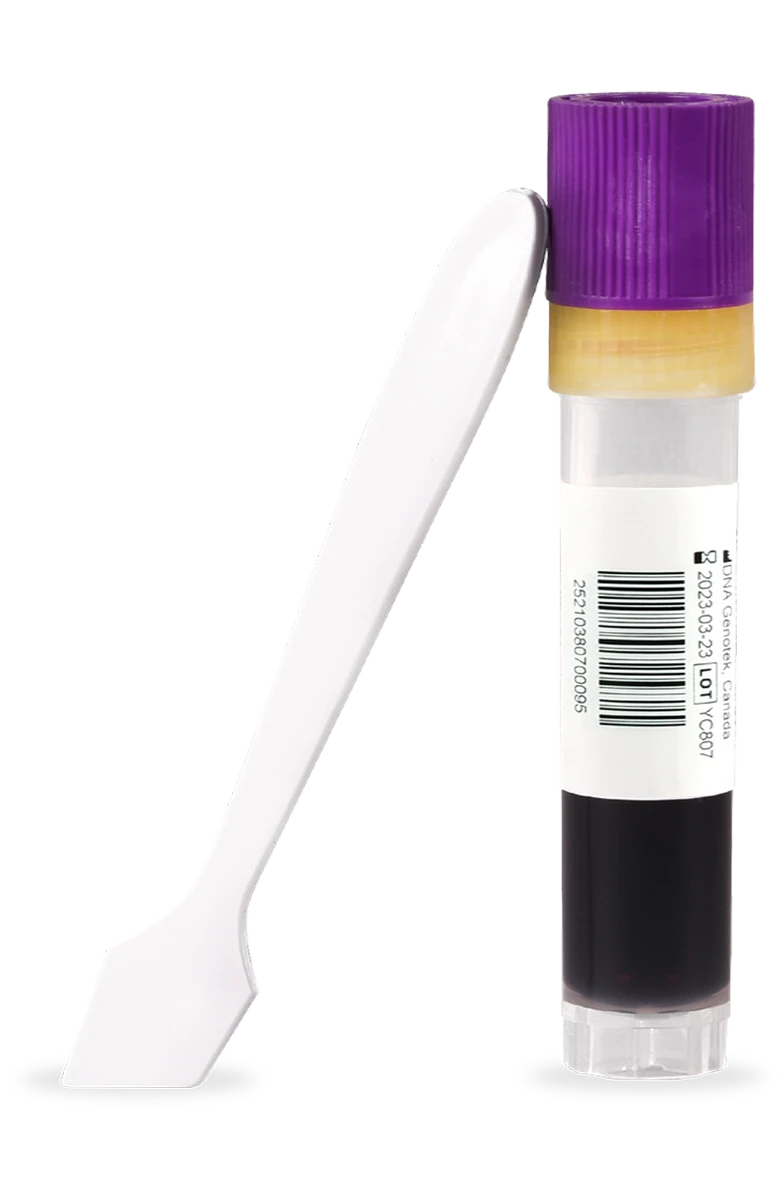
Two stool devices sit on the platform, chosen for different questions. OMNIgene·GUT, by DNA Genotek, stabilises a spatula of stool in a nucleic-acid buffer the moment the tube closes, CE-IVD marked, for 16S and shotgun microbiome sequencing and gastrointestinal work. OmicSnap, by Immundiagnostik, collects a fixed, defined mass into a prefilled stabiliser tube, so the input to a quantitative microbiome analysis is the same every time, with no variable scoop. Humans Nexus curates and supplies both and assembles the regulated kit around them; DNA Genotek and Immundiagnostik are the manufacturers.
All DNA Genotek devices on the platform → The microbiome kit →
From collection to lab.
A hygienic scoop into the OMNIgene·GUT tube, or a defined mass into the OmicSnap tube, and the stabilising buffer fixes the sample as the cap closes. For FIT, the laboratory’s sampling bottle travels in the same pack. Clean, contained, under a minute.
Sealed and ID-matched, the kit returns by standard tracked courier at ambient temperature: the buffer protects the sample, so there is no cold chain to pay for or to break.
The laboratory accessions the sample under the same chain of custody, and the result returns through the platform into your system.
A validated panel.
Stool metabolomics runs on the same ambient route: an ambient-temperature stabiliser recovered 94.5% of the metabolites seen in flash-frozen aliquots. The evidence →
Why it works now.
The barrier to stool microsampling was never the science; it was the experience and the cold chain. A stabilising buffer removes both: the sample is clean to collect, ships at room temperature and keeps the microbial community as it was in the body, which flash-freezing did at far greater cost. A defined input removes a third barrier, because microbial load varies up to tenfold between healthy people and a variable scoop makes relative abundances hard to compare. Together they turn one-off diagnostics into longitudinal gut-health tracking, and they make population-scale colorectal screening logistically simple: in randomised trials, mailing the stool test more than doubled screening completion against usual care.
What the record shows.
Each figure below belongs to the study that produced it. Where a paper’s abstract does not name the collection device, none is named here.
Each assay is validated on the stabilised sample by the laboratory before it is reported. The full reading list follows below.
Sealed. Tracked.
Ambient-stable.
The stabilising buffer fixes microbial DNA and faecal biomarkers at ambient temperature the moment the cap closes; OMNIgene·GUT is CE-IVD marked and OmicSnap is CE-marked by its manufacturer. Every kit is ID-matched and sealed, its UDI bound to a chain of custody at activation and tracked by courier scan to accessioning, with no temperature excursion to log because there is no cold chain. Each assay is validated on the stabilised sample by the laboratory before it is reported.
What’s in the box.
Stool | Cell
- OMNIgene·GUT or OmicSnap device, stabilising buffer in the tube
- Hygienic scoop and collection aid
- ID-matched, tamper-evident seal
- Tracked ambient return packaging
- Guided collection in Flow, step by step
Whoever runs the test.
Infrastructure for healthcare and life sciences. Our partners reach the patient, and we never sell directly.
Good to know.
Does the sample need refrigeration?
No. The stabilising buffer preserves microbial DNA and faecal biomarkers at room temperature, so the sample ships by standard tracked return with no cold chain.
Is stool microsampling suitable for colorectal cancer screening?
Yes, with the faecal immunochemical test, FIT, inside an organised screening pathway: the laboratory’s FIT bottle travels in the pack under the same chain of custody. Across 19 studies FIT’s pooled sensitivity for colorectal cancer was 0.79 and its specificity 0.94, and a single sample performed like several.
What can stool microsampling measure?
The gut microbiome by 16S and shotgun metagenomics, faecal occult blood by FIT, inflammation markers such as calprotectin, and stool metabolomics on an ambient-stabilised sample.
Which stool collection device do you use?
OMNIgene·GUT by DNA Genotek for microbiome sequencing and gastrointestinal work, and OmicSnap by Immundiagnostik where a defined mass is the point, both curated and supplied by Humans Nexus and assembled into the regulated kit.
Does a stabilised sample match a frozen one?
For sequencing, yes: stool stabilised at room temperature and frozen later gave 16S and shotgun profiles statistically indistinguishable from fresh-frozen aliquots of the same specimen. For metabolomics, an ambient stabiliser recovered 94.5% of the metabolites seen in flash-frozen stool, with strong agreement in their abundances.
Why does the amount of stool matter?
Because microbial load varies up to tenfold between healthy people. A variable scoop makes relative abundances hard to compare across samples and over time; a defined mass into a defined volume of stabiliser, which is what OmicSnap fixes, is what makes counts comparable.
Is the collection hygienic?
Yes. A hygienic scoop or collection aid delivers a small amount into a sealed, buffered tube, so nothing is handled twice and nothing leaks in transit.
Can a child’s stool be collected at home?
Yes. In a 2021 study stool was taken from infants’ nappies straight into an ambient stabiliser and matched flash-frozen aliquots. A parent collects, guided step by step in Flow, and the kit returns the same way. Pediatric microsampling →

Library Stool microsampling
Every paper read and summarised in our own words, each on a page of its own in the OpenSampling Library.
Newest
Detection of Cryptosporidium hominis by clinical metagenomics in stool samples from an outbreak of diarrhoea among British military personnel in Kenya
Read in the LibraryGut Microbial Variations Associated With Proton Pump Inhibitor Use in the Boston Puerto Rican Health Study
Read in the LibraryPerioperative Antibiotic Prophylaxis in Cesarean Section and the Maternal Gut Microbiome: Protocol for a Remote Observational Cohort Study
Read in the LibraryStool and vaginal microbiome profiles patterns among Black and White endometrial cancer survivors: A pilot study in North Carolina
Read in the LibraryIntegrating Microsampling in Human Biomonitoring: Methodologies, Regulatory Frameworks, and Case Study Insights
Read in the LibraryAssociations of self-reported and actigraphic sleep with gut microbiome composition and diversity among older adults
Read in the Library
Microbiome
Detection of Cryptosporidium hominis by clinical metagenomics in stool samples from an outbreak of diarrhoea among British military personnel in Kenya
Read in the LibraryGut Microbial Variations Associated With Proton Pump Inhibitor Use in the Boston Puerto Rican Health Study
Read in the LibraryPerioperative Antibiotic Prophylaxis in Cesarean Section and the Maternal Gut Microbiome: Protocol for a Remote Observational Cohort Study
Read in the LibraryStool and vaginal microbiome profiles patterns among Black and White endometrial cancer survivors: A pilot study in North Carolina
Read in the LibraryAssociations of self-reported and actigraphic sleep with gut microbiome composition and diversity among older adults
Read in the LibraryAssociations between the gut microbiome and diet, body composition, and glycemic profiles: a cross-sectional post-hoc analysis of the Personal Diet Study
Read in the Library
Ambient stabilisation
Detection of Cryptosporidium hominis by clinical metagenomics in stool samples from an outbreak of diarrhoea among British military personnel in Kenya
Read in the LibraryPerioperative Antibiotic Prophylaxis in Cesarean Section and the Maternal Gut Microbiome: Protocol for a Remote Observational Cohort Study
Read in the LibraryProspective evaluation of different faecal preservation media for travellers' diarrhoea diagnostic application with multiplex PCR BioFire FilmArray in resource-limited settings
Read in the LibraryStabilized and unstabilized sampling methods result in differential fecal 16S rRNA microbial sequencing results
Read in the LibraryAssociation of Gut Dysbiosis with Disease Phenotype and Treatment in Systemic Lupus Erythematosus
Read in the LibraryField expedient stool collection methods for gut microbiome analysis in deployed military environments
Read in the Library
Colorectal screening
Integrating Microsampling in Human Biomonitoring: Methodologies, Regulatory Frameworks, and Case Study Insights
Read in the LibraryComparing the Metagenomic Performance of Stools Collected from Custom Cards and 95% Ethanol in Epidemiologic Studies
Read in the LibrarySelf-sampling tools to increase cancer screening among underserved patients: a pilot randomized controlled trial
Read in the LibraryAssociations between the Gut Microbiota, Race, and Ethnicity of Patients with Colorectal Cancer: A Pilot and Feasibility Study
Read in the LibraryCross-sectional adherence with the multi-target stool DNA test for colorectal cancer screening in a medicaid population
Read in the Library"CUIDARAS " : A Nominal and Personalized Health Care Model. Effectiveness of a Massive Screening for Colorectal Cancer Detection at Community level
Read in the Library
Standardised input
Toward a human whole-stool reference material for metabolomic and metagenomic gut-microbiome measurements
Read in the LibraryImpact of sampling regions and storage methods on fecal gut microbiome and metabolome profiles
Read in the LibraryQuantitative microbiome profiling links gut community variation to microbial load
Read in the Library
One free account opens every finding in the OpenSampling Library. The same account signs you in to Pulse.
These citations describe the published evidence for the collection formats and devices, not claims about specific Humans Nexus assays, which are validated per analyte and per laboratory.
Put stool on the platform.
Talk to us about adding stool collection to your programme.