Blood microsampling,
without the venous draw.
A few microlitres of capillary blood, self-collected at home or drawn at the point of care and returned to an ISO 15189-accredited laboratory under documented chain of custody. Dried on a VAMS tip or a dried blood spot card, or kept liquid where the assay needs the whole specimen: the matrix that carries most of the clinical menu, finally freed from the needle and the draw chair.
What is blood microsampling?
Blood microsampling is the precisely metered collection of a small capillary blood specimen, typically tens of microlitres from a finger-prick or hundreds of microlitres from the upper arm, self-collected at home or taken at the point of care and returned to an ISO 15189-accredited laboratory under documented chain of custody. It replaces the venous draw and the phlebotomy appointment with a patient-centric collection device, stabilisation matched to the analyte, and software that lands structured results in the laboratory.
It is the flagship of microsampling because blood carries the broadest clinical menu: routine chemistry, metabolic and cardiovascular markers, many hormones, drug levels and serology all live here. Move blood collection out of the clinic and most of the test catalogue moves with it, which is why remote blood collection is the first thing a decentralised clinical trial or a therapeutic drug monitoring programme asks for.
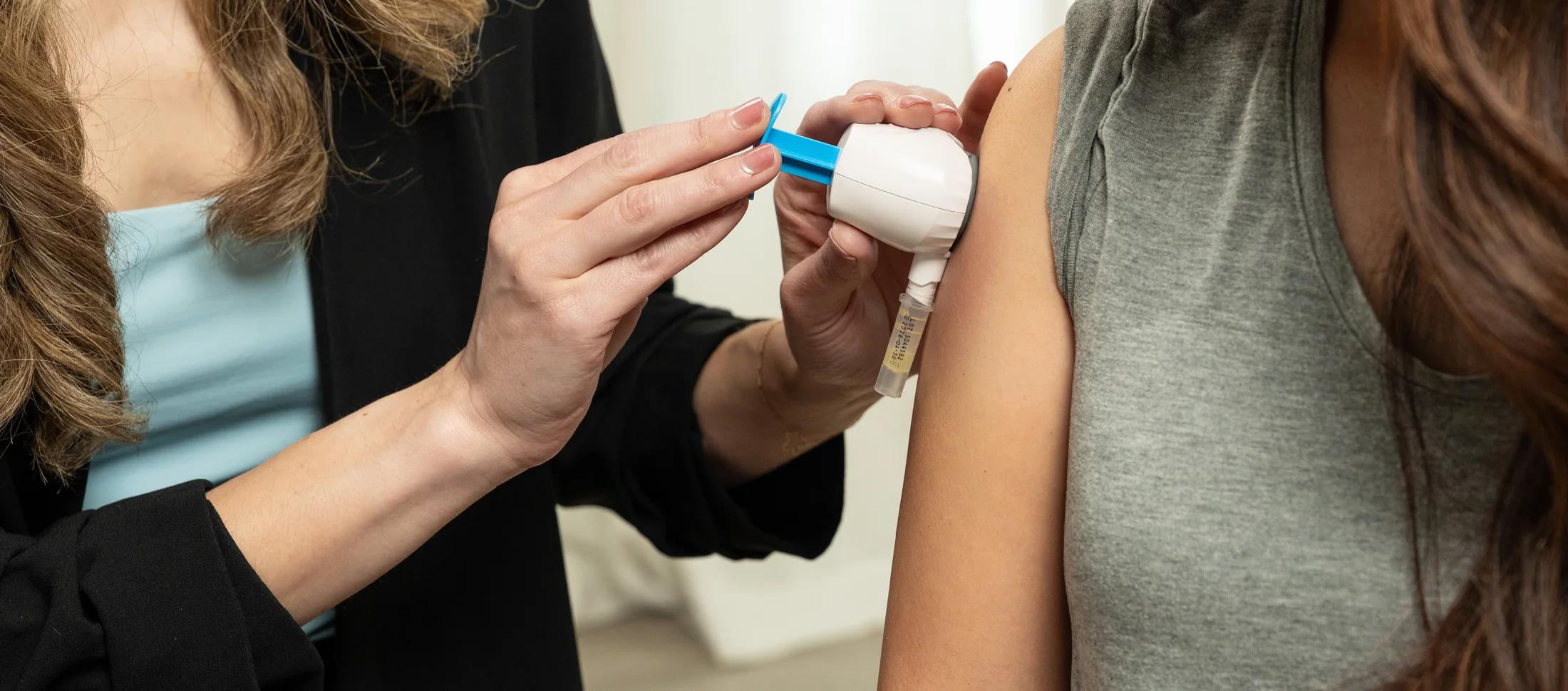
The needle was
the bottleneck.
Clinic-and-needle dependency quietly caps everything downstream. It limits who enrols, how often you can sample, how diverse a cohort you can reach, and what each data point costs, and a large share of adults actively avoid blood draws. Capillary microsampling, patient-centric sampling in the industry’s own phrase, removes that ceiling.
No appointment, no travel, no phlebotomist. Recruitment widens to people a clinic footprint never reaches, and participants stay in because sampling fits their life.
A draw chair is a hard limit on how often you can measure. A home device makes serial and longitudinal sampling routine: trajectories, not snapshots.
Stripping out the visit lowers the cost per sample and opens cohorts across geography and demographics that clinic-bound studies systematically miss.
Validated use is published across at-home HbA1c, pediatric pharmacokinetic sampling, therapeutic drug monitoring, anti-doping and decentralised clinical trials, and the papers are in the research library; remote programmes consistently report high sample-return compliance.
Dried or liquid.
The assay decides.
Capillary blood travels to the laboratory in one of two forms, and one question governs the choice: does the assay tolerate drying, or does it need the specimen intact? That single decision drives the whole logistics picture. Start from the assay and work outward: the analyte’s stability when dried decides the family; volume needs and shipping reality settle the format.
| Dried | Liquid capillary | |
|---|---|---|
| Formats | VAMS, dried blood spot | Whole capillary, plasma-separated |
| Cold chain | None, ambient | Where the assay requires |
| Volume | Microlitre, metered | Larger, whole sample |
| Best for | TDM, HbA1c, screening, broad chemistry | Assays that don’t survive drying |
| Logistics | Standard tracked return | Handling / controlled-temperature |
| Default? | Yes, first choice | The managed exception |
As a rule: choose dried unless the analyte forces liquid. Dried removes the most expensive, most failure-prone part of remote collection, the cold chain, so it is the default, and liquid is reserved for assays that genuinely need an intact sample. See how we protect each →
Most of the menu,
and what stays venous.
Honesty matters more than reach here. A large part of the routine catalogue is well-suited to validated capillary collection. A defined set of tests still belongs in a venous tube, and we say so up front.
| Well-suited to capillary | Stays venous, for now |
|---|---|
| Routine chemistry panels | Coagulation & clotting studies |
| HbA1c & glycaemic markers | ESR, erythrocyte sedimentation rate |
| Lipids & ApoB | Blood cultures |
| Vitamin D & micronutrients | Cellular morphology & blood film |
| Many hormones | Large-volume or pooled assays |
| CRP & inflammatory markers | Tests needing whole-cell integrity |
| TDM & small-molecule panels | Anything requiring >1 mL serum/plasma |
Suitability is established per analyte through method validation before any patient-facing reporting; the table is a guide to where capillary is strong, not a substitute for an assay-level decision with your laboratory.
Dried blood microsampling,
no cold chain.
Capillary blood that dries on a VAMS tip or a dried blood spot card and ships at ambient temperature by ordinary tracked post: no cold chain, no ice, no excursion risk, and a specimen stable enough to travel from a kitchen table to the bench. There are three dried formats, VAMS, the dried blood spot and quantitative DBS. We built the platform on the most accurate of them, VAMS.
We chose VAMS.
Every dried-blood format has to answer one question: how much blood is actually in the sample the laboratory analyses. A classic spot leaves it uncontrolled; VAMS fixes it at source. Volumetric absorptive microsampling wicks a fixed, known volume of capillary blood onto an absorbent tip: a set 10 to 30 µL regardless of how the blood would spread, and largely independent of haematocrit. The whole tip is then analysed, so there is no sub-sampling and no spot-area bias. That is precisely what quantitation needs, which is why VAMS is our default dried-blood solution on the platform.
Introduced by Denniff and Spooner in 2014, VAMS is now one of the most actively validated microsampling techniques in bioanalysis, with a decade of peer-reviewed method and clinical validation behind it. The evidence is aggregated below →
Volumetric, by Neoteryx.
VAMS is delivered by the Neoteryx Mitra device: an absorbent polymer tip that fills from a fingertip drop in seconds, dries on its station, and ships at ambient temperature. The laboratory elutes the whole tip and runs the validated assay. Humans Nexus curates and supplies the device on the platform and assembles the regulated kit around it; Neoteryx is the manufacturer.
Three ways to dry a sample.
All three dry the blood and ship it ambient. They differ in one thing, whether the volume analysed is controlled, and that difference decides which analytes each can quantify.
| VAMS | Dried blood spot | Quantitative DBS | |
|---|---|---|---|
| Principle | Absorbent tip wicks a set volume | Free drops onto a card | Metered volume onto a card |
| Volume control | Fixed at the tip | Uncontrolled, sub-punch of a free spot | Fixed by microfluidic metering |
| Haematocrit–area bias | Removed by design | Present on classic cards | Removed at source |
| Analysed portion | The whole tip | A punched sub-disc | The whole metered disc |
| Best-established use | Quantitative TDM, LC-MS/MS | Newborn & population screening, serology | Quantitative work on a card |
| Ambient shipping | Yes, no cold chain | Yes, no cold chain | Yes, no cold chain |
VAMS, the volumetric tip
The tip absorbs a fixed volume and is analysed whole, so the area-bias and homogeneity problems of a spot are removed by design. An honest nuance for method developers: removing the volumetric bias does not make every assay perfectly haematocrit-independent a residual, haematocrit-dependent recovery effect can persist for some analytes, so each assay is still validated per analyte rather than assumed. It is the format built for quantitation.
Dried blood spot, the proven classic
The dried blood spot is the original micro-volume format, and its pedigree is more than six decades deep: population newborn screening, tens of millions of infants a year, runs on it, and because immunoglobulins are stable when dried and serology reads a ratio rather than an absolute volume, DBS underpins large-scale antibody surveillance too. Its strengths are real. Its limitation is specific and narrow: getting an accurate concentration from a fixed sub-punch of a spot formed from an unknown volume, where the haematocrit effect, sub-punch variability and non-uniform analyte spreading all bear on the result. The card is excellent; the uncontrolled volume is the caveat. Because the dried matrix preserves nucleic acids at ambient temperature, a dried blood spot is also a stable source of genomic DNA: genotyping, pharmacogenomics and sample-identity checks run from a punched disc, and whole-genome sequencing has been achieved from archived newborn cards.
Quantitative DBS: the spot, upgraded
Quantitative DBS keeps everything patients and labs like about the card, finger-prick, dried paper, ambient post, and fixes the one weakness: it meters a precise, known volume onto the card and analyses the whole disc, so there is no sub-punch and no haematocrit-driven area bias. It is best understood not as a different sample type but as the dried blood spot done quantitatively: the classic card, with the volume brought under control.
Which format, when.
Quantitation where a fixed, known volume decides the result: therapeutic drug monitoring, LC-MS/MS small molecules, quantitative biomarkers. Our default.
Ratio and threshold assays and validated screening at scale, newborn and population programmes, serosurveillance, where the classic card is proven and economical.
The card format kept, with volumetric metering added, for quantitative work that still wants a paper disc rather than a tip.
Whichever format fits, suitability is established per analyte through method validation before any patient-facing result; the format is chosen for the assay, not the other way round.
Validated before it reports.
Because dried formats can carry haematocrit and recovery considerations, every panel is validated per analyte along a research-to-clinical transfer pathway into ISO 15189-accredited laboratories, both analytical validation and clinical validation against a venous reference. Where a plasma-equivalent result is reported from capillary blood, an established, analyte-specific capillary-to-plasma relationship is applied, following the IATDMCT guideline on capillary-to-plasma conversion. VAMS, the Neoteryx Mitra, is a CE-marked component within those validated kits.
The reference frameworks a laboratory implements against, the IATDMCT guidelines on dried-blood method validation and on capillary-to-plasma conversion, are listed in the reading below.
Liquid capillary blood,
more than a fingerstick.
Whole capillary blood, kept intact for the assays that don’t survive drying: hundreds of microlitres drawn from the upper arm, or a finger-prick volume, self-collected at home or taken at the point of care, with handling and, where the assay requires it, controlled-temperature transport.
What is liquid
capillary collection?
Liquid capillary blood microsampling collects a small volume of whole blood from the upper arm or fingertip and keeps it in liquid form rather than drying it, so the sample reaches the laboratory intact. It is the family for assays that need the whole sample, and for downstream plasma separation. Because liquid blood is less stable than a dried sample, it travels stabilised and, where the assay requires, under controlled-temperature transport.
Where dried is the default, liquid is the managed exception, reserved for analytes that genuinely need an intact sample, and run through the same accredited-laboratory path under documented chain of custody.
Drawn from the arm.
Liquid capillary devices draw whole blood from the upper arm or fingertip without a phlebotomist, a small applicator the patient activates at home or a clinician applies at the point of care. The makers describe the experience as far gentler than a venous draw.
YourBio TAP Micro Select → · BD Microtainer →
Comfort claims above are attributed to each device maker. Humans Nexus does not make an independent pain claim.
Handled, where the assay requires.
A liquid sample is less forgiving than a dried one, so logistics does more of the work. Where the analyte allows, chemical stabilisation, preservatives, buffers and internal standards, protects the sample in transit. Where it doesn’t, controlled-temperature transport is orchestrated and temperature-logged from collection to accessioning.
Preservatives and buffers protect the analyte in transit, chemical stabilisation doing the work refrigeration otherwise would, where the assay allows.
For cold-chain-dependent analytes, controlled-temperature packaging is temperature-logged end to end and moved on medical courier networks.
ID-matched, tamper-evident, every leg recorded, the audit trail that lets a liquid result be trusted for a medical decision.
Controlled-temperature transport is applied only where the assay requires it, never by default. See how we protect the sample →
Plasma, without the centrifuge.
Many assays are validated on plasma, not whole blood, which traditionally means a centrifuge and a lab bench. At-home plasma separation is an emerging capability that separates plasma from a capillary sample at the point of collection, without a centrifuge, so a plasma-ready sample can be returned from home.
It is a developing area, and we treat it that way: deployed per assay, where the separation method is validated for the analyte and the laboratory has signed off on the workflow. Where it fits, it extends remote collection to plasma-based panels that liquid whole blood alone can’t serve, without sending the patient to a clinic.
From a fingertip
to a signed result.
A home-collected sample is only clinical-grade if it arrives as the sample the patient gave. Every step carries identity, integrity and a record, the audit trail that lets a result be trusted for a medical decision.
The patient draws a metered capillary sample with the device, ID-matched and sealed tamper-evident at the moment of collection, with on-screen collection guidance to get it right first time.
Dried formats ship ambient by tracked return; liquid travels stabilised, controlled-temperature where the assay requires, every leg logged.
An ISO 15189-accredited laboratory accessions the sample, runs the validated assay, and our software lands clean, structured results in your system.
Humans Nexus integrates accredited laboratories; we never run, or compete with, a lab. We provide the regulated kit, the clinical-grade logistics and the software that connect the patient to the laboratory you already trust.
What the record shows.
Each figure below belongs to the device and the study that produced it. Where a study used another maker’s device, it is cited for what it proves about the method, and the device is not named.
Every panel on the platform is still validated per analyte, following the IATDMCT guideline on capillary-to-plasma conversion, before a result is reported. The full reading list follows.

Library Blood microsampling
Every paper read and summarised in our own words, each on a page of its own in the OpenSampling Library.
Newest
Clinical Validation of Venetoclax Volumetric Microsampling in Leukemia, with Whole-Blood-to-Plasma Conversion and Self-Microsampling Feasibility
Read in the LibraryTo Convert or Not to Convert? Official IATDMCT Guideline on Converting Capillary-Blood Microsampling Concentrations to Plasma Concentrations
Read in the LibraryVolumetric Absorptive Microsampling During Spaceflight for Analysis of Acetaminophen Pharmacokinetics in Whole Blood
Read in the LibraryLiquid Chromatographic Methods for Microsampling in Sports Drug Monitoring: Progress in DBS and VAMS
Read in the LibraryReal-world evaluation of capillary microsampling for drug monitoring of anti-seizure medications
Read in the LibrarySurrogate-based LC-MS/MS quantification of endogenous creatinine in plasma, plasma-equivalent dried spots (qDPS), and volumetric absorptive microsampling (VAMS): an ICH M10-compliant bridging study
Read in the Library
Dried blood spot
Clinical Validation of Venetoclax Volumetric Microsampling in Leukemia, with Whole-Blood-to-Plasma Conversion and Self-Microsampling Feasibility
Read in the LibraryLiquid Chromatographic Methods for Microsampling in Sports Drug Monitoring: Progress in DBS and VAMS
Read in the LibraryA Review of Blood-Based Microsampling Devices for Patient-Centered Application in Therapeutic Drug Monitoring
Read in the LibraryVolumetric absorptive microsampling for profiling of signaling lipids: a comparative analysis with whole blood and dried blood spots
Read in the LibraryClinical validation of a DBS-based LC-MS/MS method for 25-hydroxyvitamin D: from lab sampling to home sampling
Read in the LibraryPrevalence of chlamydial, gonococcal and syphilis positivity by anatomical site and sex via self-collected biospecimens using at-home testing kits among a large and diverse cohort of men and women enrolled in the MACS/WIHS Combined Cohort Study (MWCCS) in the USA
Read in the Library
VAMS
Clinical Validation of Venetoclax Volumetric Microsampling in Leukemia, with Whole-Blood-to-Plasma Conversion and Self-Microsampling Feasibility
Read in the LibraryVolumetric Absorptive Microsampling During Spaceflight for Analysis of Acetaminophen Pharmacokinetics in Whole Blood
Read in the LibraryLiquid Chromatographic Methods for Microsampling in Sports Drug Monitoring: Progress in DBS and VAMS
Read in the LibraryReal-world evaluation of capillary microsampling for drug monitoring of anti-seizure medications
Read in the LibrarySurrogate-based LC-MS/MS quantification of endogenous creatinine in plasma, plasma-equivalent dried spots (qDPS), and volumetric absorptive microsampling (VAMS): an ICH M10-compliant bridging study
Read in the LibraryEvaluation of hematocrit-adjusted conversion strategies for mycophenolic acid and tacrolimus monitoring using volumetric absorptive microsampling in lung and renal transplant recipients
Read in the Library
Liquid
Volumetric absorptive microsampling for profiling of signaling lipids: a comparative analysis with whole blood and dried blood spots
Read in the LibrarySalivary estradiol and progesterone across the menstrual cycle: Association and agreement with serum concentrations
Read in the LibraryUltrasensitive de novo Protein Sandwich Lateral flow Fluorescence Assay for Cortisol in Saliva and Serum using Quantum dots and Europium Nanoparticles
Read in the LibraryGlycemic assessment in diabetic patients with secondary polycytheamia: limitations of HbA1c and the potential role of fructosamine-a prospective comparative study
Read in the LibraryFrom Home to Transcriptome: Comparing the Transcriptomic Profile of Induced Immune Response via Lipopolysaccharide Stimulation in homeRNA and Venous Blood
Read in the LibraryUse of the GTT@home Oral Glucose Tolerance Test Kit in Gestational Diabetes Mellitus: Performance Evaluation Study
Read in the Library
Quantitative DBS
Real-world evaluation of capillary microsampling for drug monitoring of anti-seizure medications
Read in the LibraryPatient-centric capillary dried blood spot sampling for tacrolimus and creatinine monitoring in clinical practice
Read in the LibraryMatrix fidelity in microsampling: Plasma-first LC-MS/MS quantification of mycophenolic acid and MPAG
Read in the LibraryAn LC-MS untargeted metabolomic comparison between three blood microsampling devices, whole blood, and plasma
Read in the LibraryPopulation pharmacokinetic modeling and simulation-informed ceftazidime dosing in Chinese neonates using quantitative dried blood spot micro-sampling
Read in the LibraryDevelopment and application of a multimatrix LC-MS/MS method for quantifying elexacaftor-tezacaftor-ivacaftor: Expanding therapeutic drug monitoring in cystic fibrosis from systemic circulation to airways and sweat
Read in the Library
Standards & guidance
To Convert or Not to Convert? Official IATDMCT Guideline on Converting Capillary-Blood Microsampling Concentrations to Plasma Concentrations
Read in the LibraryUK recommendations for the validation and adoption of capillary blood testing within the routine clinical laboratory: Consensus opinion from the LabMed patient-centred testing and sampling (PaCTS) group
Read in the LibraryIntegrating Microsampling in Human Biomonitoring: Methodologies, Regulatory Frameworks, and Case Study Insights
Read in the LibrarySample volume management: the role of the clinical laboratory in minimizing diagnostic blood loss
Read in the LibraryRegulatory Interactions and Learnings-RADIAL the Trials@Home Proof-of-Concept Trial on Decentralization
Read in the LibraryStandardization of Microsampling Technologies for Accurate Sensing and Reliable Diagnostics
Read in the Library
One free account opens every finding in the OpenSampling Library. The same account signs you in to Pulse.
These citations describe the published evidence for the collection formats and devices, not claims about specific Humans Nexus assays, which are validated per analyte and per laboratory.
Whoever runs the test.
Infrastructure for healthcare and life sciences. Our partners reach the patient, and we never sell directly. Pharma & decentralised trials →
Good to know.
Is capillary blood as accurate as a venous draw?
For a validated panel, yes, and the published record says so per analyte: fingerprick Mitra within 20% of venous for 88% of tacrolimus measurements, capillary lipidomes indistinguishable from venous plasma, and four upper-arm devices agreeing with venous blood alike. Suitability is established per analyte through method validation before any patient-facing reporting.
Which blood tests can be collected at home?
A large part of the routine menu: chemistry panels, HbA1c, lipids and ApoB, vitamin D, many hormones, CRP and therapeutic drug monitoring. A defined set still belongs in a venous tube: coagulation, ESR, blood cultures, cellular morphology and large-volume assays.
Should I choose dried or liquid?
Choose dried unless the analyte forces liquid. Dried formats, VAMS and dried blood spot, ship at ambient temperature with no cold chain and are the default. Liquid capillary is reserved for assays that need an intact sample, and may require controlled-temperature transport. Liquid is needed when the assay won’t tolerate drying, needs a larger or whole sample, or requires plasma, and is validated on liquid capillary blood.
Does home blood collection need a cold chain?
Usually not. Once dry, the VAMS tip and the DBS card are stable at ambient temperature by design and ship by standard tracked return, with no refrigeration and no temperature logging, which is why dried is the default for remote blood collection. Liquid samples sometimes do: where the analyte allows, chemical stabilisation protects the sample at ambient temperature; where it doesn’t, controlled-temperature transport is temperature-logged from collection to accessioning, applied only where the assay requires it.
What is volumetric blood sampling?
Collection of a fixed, known volume of capillary blood, so the laboratory quantifies against a volume it can trust. VAMS fixes the volume at the tip and analyses the whole tip; quantitative DBS meters the volume onto a card. It is the difference between a screening result and a quantitative one, and why VAMS is the platform’s default dried format.
How much blood does a microsample need?
Typically tens of microlitres, a fraction of a venous tube. The exact volume depends on the device and the assay; metered formats capture a fixed, known volume to support quantitation.
How is VAMS different from a dried blood spot?
VAMS absorbs a fixed, known volume on a tip and is analysed whole, removing the spot-volume and homogeneity variability that limit quantitation from a classic dried blood spot. Quantitative DBS reaches the same goal on a card by metering a fixed volume onto it. The dried blood spot itself remains excellent for threshold assays such as serology.
Does VAMS remove the haematocrit effect entirely?
It removes the volumetric/area bias by design, but not automatically every haematocrit influence; a residual, analyte-dependent recovery effect can remain. That is why each assay is validated per analyte rather than assumed to be haematocrit-independent.
Is the dried blood spot less accurate?
Not in general. DBS is proven and excellent for ratio and threshold assays, newborn screening and serology run on it, and for many validated drugs. Its limitation is specific: absolute quantitation from a fixed sub-punch of a spot made from an uncontrolled volume. Where that matters, VAMS or quantitative DBS is the better choice.
Can DNA be extracted from a dried blood spot?
Yes. The dried matrix preserves nucleic acids at ambient temperature, so a dried blood spot is a stable source of genomic DNA for genotyping, pharmacogenomics and sample-identity checks, extracted from a punched disc with standard lysis and purification; newborn screening cards have yielded whole-genome sequences years after collection. DNA yield follows the volume on the card, which is one more reason metered formats matter.
Can a home capillary result substitute for a venous draw?
For well-characterised analytes, yes: clinical-validation studies report good agreement with venous blood, and where a plasma-equivalent result is needed an established capillary-to-plasma relationship is applied. It is established per analyte, following international TDM guidance, before any patient-facing reporting.
Are the devices regulated?
The TAP Micro Select is CE marked, registered in EUDAMED and FDA 510(k) cleared; Neoteryx Mitra, VAMS, is a CE-marked component within validated kits, with method validation in ISO 15189-accredited laboratories before patient-facing reporting. Device-level regulatory status is held by the manufacturer; Humans Nexus assembles the regulated kit around it.
Which devices collect liquid capillary blood?
The YourBio TAP Micro Select draws whole capillary blood from the upper arm, without a phlebotomist, straight into a BD Microtainer tube, within validated kits run into ISO 15189-accredited laboratories under documented chain of custody.
Is liquid capillary collection virtually painless?
YourBio TAP Micro Select draw is virtually painless, and in Oxford’s Diabetes Care study 63% of children and adults preferred it to a needle. The comfort claim is the maker’s and the patients’; Humans Nexus makes no independent pain claim.
Can plasma be collected at home?
At-home plasma separation is an emerging, centrifuge-free capability that separates plasma from a capillary sample at the point of collection. It is deployed per assay, where the method is validated for the analyte and the laboratory has approved the workflow.
Does Humans Nexus run the laboratory?
No. We integrate ISO 15189-accredited laboratories and never run or compete with a lab. We provide the regulated kit, clinical-grade logistics and the platform that connect the patient to the accredited laboratory.
Build on blood microsampling.
Talk to us about putting remote, clinical-grade blood collection on your platform.