Neoteryx Mitra.
Exact volume, single touch.
Neoteryx Mitra is the volumetric absorptive microsampling device, VAMS: an absorbent tip that takes a fixed 10, 20 or 30 µL of capillary blood from a finger-prick in seconds, whatever the hematocrit, two or four tips to a device, so one finger-prick can fill up to four tips, each of which Humans Nexus can prepare with a different additive for a different assay. The tips dry and ship at ambient temperature for quantitative work, therapeutic drug monitoring above all. CE-IVD registered under the IVDR. Curated and supplied on the Humans Nexus platform; Neoteryx is the manufacturer.
A fixed volume,
on a tip.
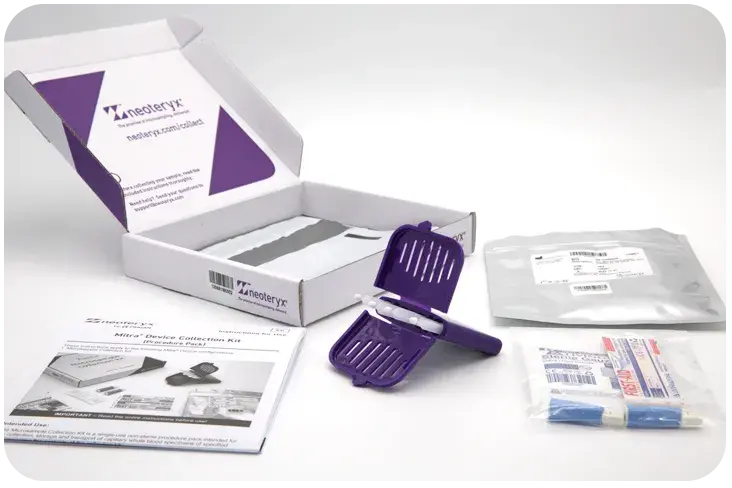
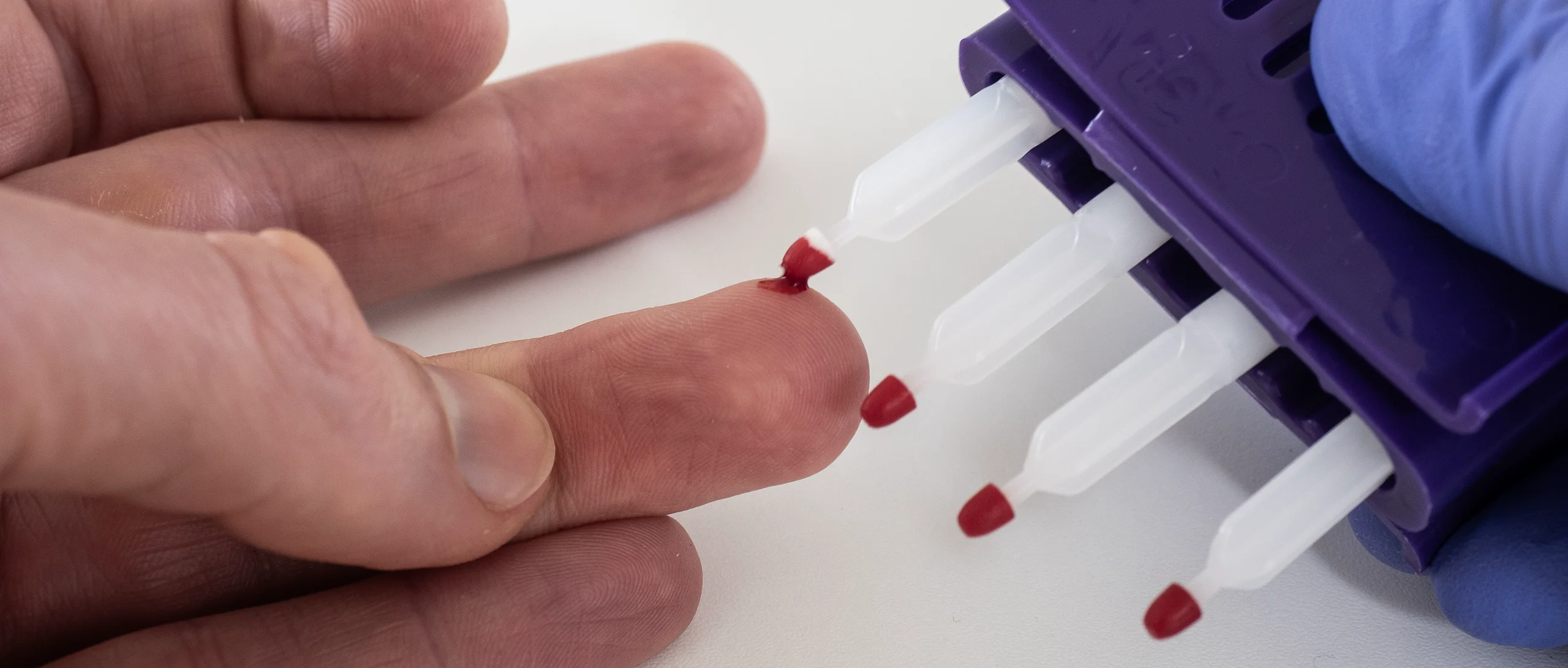
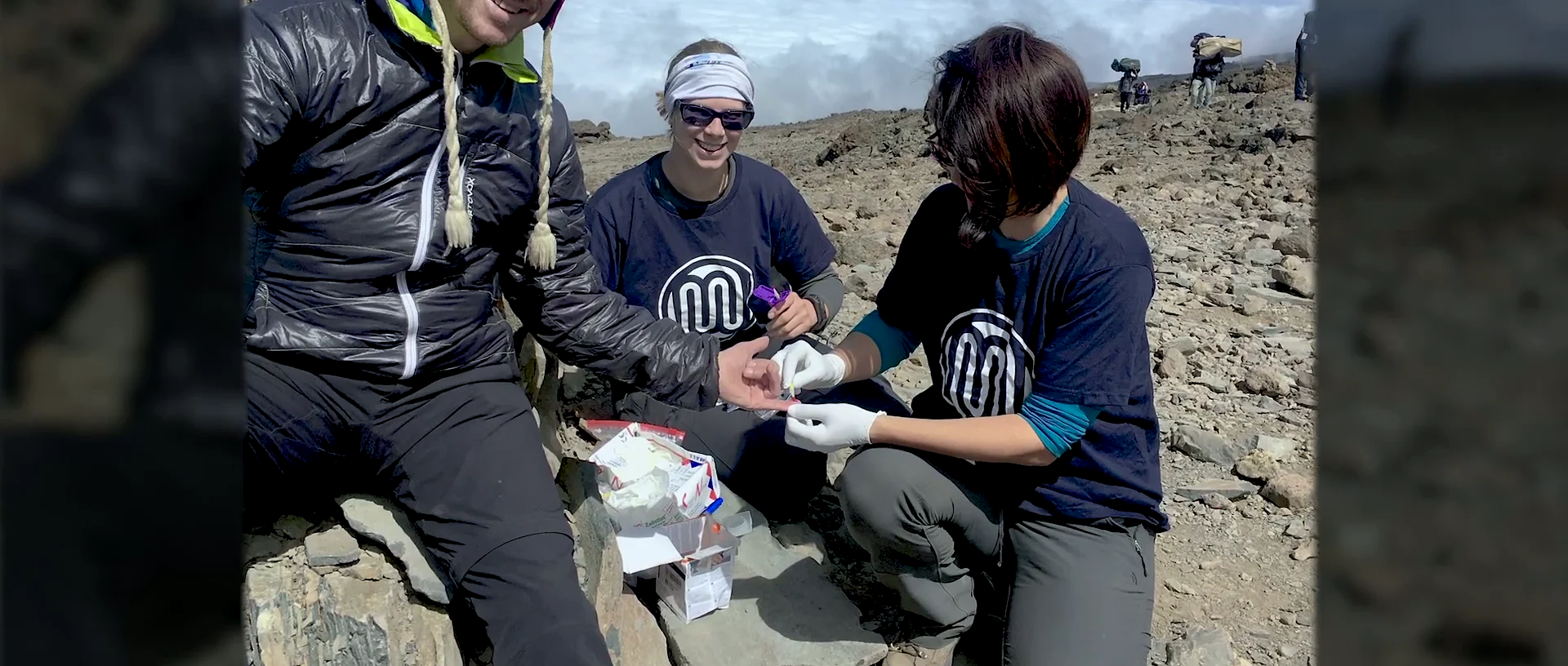
The Mitra device uses VAMS, volumetric absorptive microsampling. Touch its absorbent tip to a drop of blood on a fingertip and it wicks a fixed volume in seconds, 10, 20 or 30 µL, the same every time, whatever the hematocrit. You know it’s full when the tip turns fully red; the manufacturer specifies volumetric precision within about 5%, an RSD of 5% or better. The tip then dries, ships at ambient temperature with no cold chain, and needs no centrifugation before the laboratory elutes it and runs the assay. Humans Nexus curates and supplies the device on its platform; Neoteryx is the legal manufacturer. In the maker’s words, Mitra devices are CE-IVD devices under the IVDR, intended as specimen collectors for the storage and transport of blood and other biological fluids, registered as IVDs in the European Union, the United Kingdom, Australia, Brazil, China and Canada, and supplied as research use only in the United States.
Where the spot
falls short.
A traditional dried blood spot varies with volume and with hematocrit, which limits quantitation. VAMS captures a fixed volume on each tip, which the manufacturer designs for the reproducibility quantitative assays demand: therapeutic drug monitoring, LC-MS/MS small molecules, and biomarker panels transferred from venous methods.
What the record shows.
Each figure below belongs to the study that produced it. Mitra is named only where the paper’s abstract names it; VAMS is the format.
Every panel is validated per analyte, following the IATDMCT guideline on capillary-to-plasma conversion, before a result is reported. The full VAMS reading list follows below.
Touch. Dry. Return.
Touch the tip to a fingertip drop; it wicks a fixed 10–30 µL in seconds and turns fully red when it’s done.
The tip dries on its station, stable at ambient temperature.
Ships by tracked return with no cold chain; the lab elutes and runs the validated assay.
Assembled into a kit.
Mitra is curated onto the platform and assembled into a regulated Humans Nexus collection kit: device, safety lancet, drying station, ambient-stable return packaging and instructions, under its own UDI.
For quantitative work.
Good to know.
How much blood does it take?
A fixed 10, 20 or 30 µL per tip, chosen for the assay, a fraction of a venous tube from a single finger-prick; a device carries two or four tips. The tip absorbs the same volume every time, RSD ≤ 5% per the manufacturer, and it turns fully red when it is full, which is what makes the dried sample quantitative.
How is Mitra different from a dried blood spot?
Mitra absorbs a fixed, known volume per tip, which the manufacturer designs to reduce the volume and hematocrit variability that limit traditional dried blood spots, so quantitative assays are more reliable.
What is VAMS best for?
Quantitative work: therapeutic drug monitoring, LC-MS/MS small-molecule assays, and biomarker panels transferred from venous methods. VAMS is widely used in TDM and PK research.
Does it need refrigeration?
No. The dried tip is stable at ambient temperature and ships by standard tracked return, with no cold chain.
Is Mitra CE marked?
Yes. In the maker’s words, Mitra devices are CE-IVD devices under the IVDR, registered as IVDs in the European Union, the United Kingdom, Australia, Brazil, China and Canada, and supplied as research use only in the United States. Device-level status is held by Neoteryx; each assay is validated per analyte before a patient-facing result.
Does hematocrit affect the result?
The tip’s volume does not: under 5% variation from 20 to 70% hematocrit in the founding study, and no hematocrit-dependent bias where the dried blood spot has one. Recovery can fall at high hematocrit for some analytes, so each is validated with a hematocrit-aware conversion where needed, following the IATDMCT guideline on the blood page.
Can patients collect Mitra samples at home?
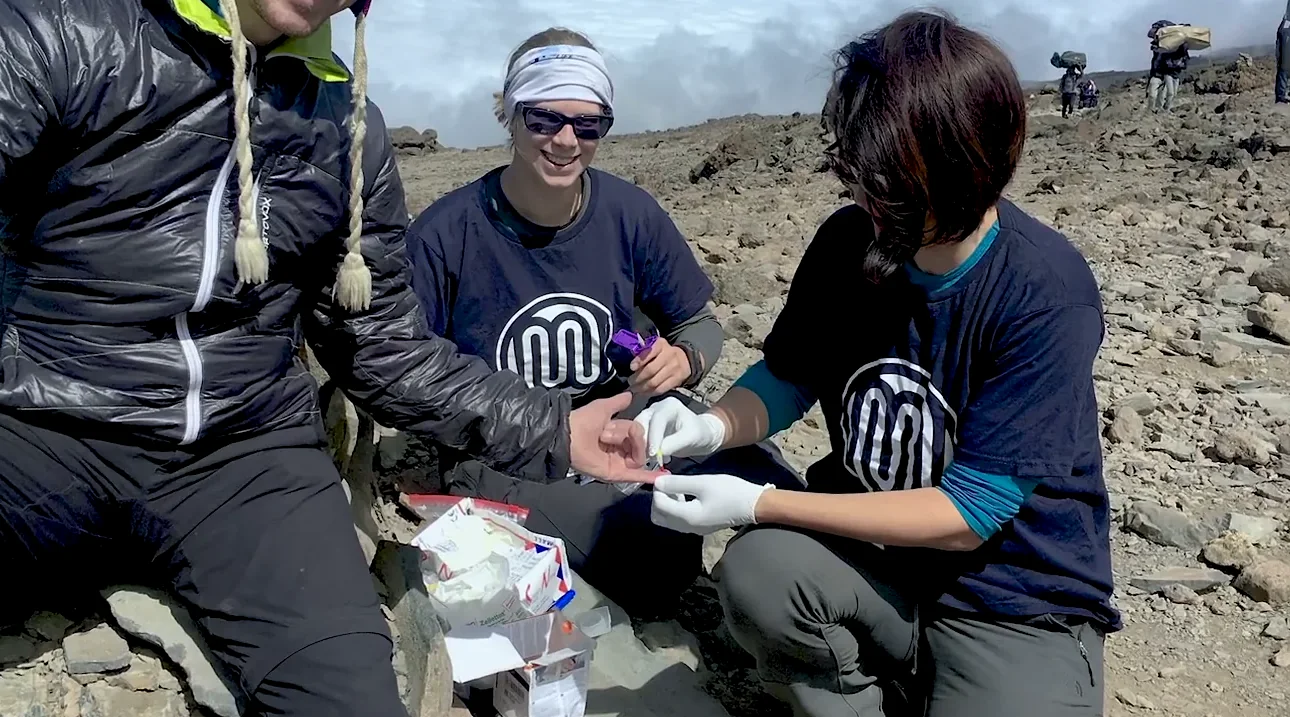
Yes, with guidance. In cancer patients 93.1% of 591 at-home samples were collected correctly, and in paediatric heart transplant tacrolimus on the dried tip was unaffected by postal shipping. The honest counterpoint: in one pilot in critically ill children, 29% of capillary tips were unusable for collection issues, which is why collection is guided step by step in Flow.
How many tips per device, and can they differ?
Two or four tips to a device, so one finger-prick can fill up to four tips, and Humans Nexus can prepare each tip with a different additive, so one collection can serve more than one assay.
Who is the manufacturer?
Neoteryx makes the Mitra device. Humans Nexus curates and supplies it on the platform and assembles the regulated kit around it. Method validation runs per assay before patient-facing reporting.

Library Neoteryx Mitra
Peer-reviewed studies that used Neoteryx Mitra, organised by where it is used: immunosuppressant, biologic, oncology and antimicrobial drug monitoring; biomarkers, vitamins and omics; infectious-disease serology; urine steroids and toxicology; and the haematocrit question the format was built to answer. Every paper opens its page in the OpenSampling Library, with a link to an open-access copy where one exists. This is evidence for the device, not a claim about any specific Humans Nexus assay.
Newest
Clinical Validation of Venetoclax Volumetric Microsampling in Leukemia, with Whole-Blood-to-Plasma Conversion and Self-Microsampling Feasibility
Read in the LibraryVolumetric Absorptive Microsampling During Spaceflight for Analysis of Acetaminophen Pharmacokinetics in Whole Blood
Read in the LibraryEvaluation of hematocrit-adjusted conversion strategies for mycophenolic acid and tacrolimus monitoring using volumetric absorptive microsampling in lung and renal transplant recipients
Read in the LibraryCefepime pharmacokinetics in critically ill children with multiple organ dysfunction syndrome using volumetric absorptive microsampling
Read in the LibraryVolumetric absorptive microsampling for profiling of signaling lipids: a comparative analysis with whole blood and dried blood spots
Read in the LibraryVolumetric Absorptive Microsampling (VAMS) for Therapeutic Drug Monitoring of Antiseizure Medications (ASMs) in Pediatric Patients
Read in the Library
Method validation
Clinical Validation of Venetoclax Volumetric Microsampling in Leukemia, with Whole-Blood-to-Plasma Conversion and Self-Microsampling Feasibility
Read in the LibraryEvaluation of hematocrit-adjusted conversion strategies for mycophenolic acid and tacrolimus monitoring using volumetric absorptive microsampling in lung and renal transplant recipients
Read in the LibraryVolumetric absorptive microsampling for profiling of signaling lipids: a comparative analysis with whole blood and dried blood spots
Read in the LibraryVolumetric Absorptive Microsampling (VAMS) for Therapeutic Drug Monitoring of Antiseizure Medications (ASMs) in Pediatric Patients
Read in the LibraryApplication of volumetric absorptive microsampling (VAMS) for the simultaneous determination of cadmium and lead in blood
Read in the LibrarySystematic evaluation of propofol population pharmacokinetic models and development of a literature-supported new meta-model for critically ill preterm and term neonates
Read in the Library
Haematocrit
Clinical Validation of Venetoclax Volumetric Microsampling in Leukemia, with Whole-Blood-to-Plasma Conversion and Self-Microsampling Feasibility
Read in the LibraryEvaluation of hematocrit-adjusted conversion strategies for mycophenolic acid and tacrolimus monitoring using volumetric absorptive microsampling in lung and renal transplant recipients
Read in the LibraryDevelopment and application of an LC-MS/MS method for 8 antiepileptic drugs and 2 metabolites using microsampling techniques (DBS and VAMS)
Read in the LibraryMulti-Matrix LC-MS/MS Validation of Methotrexate Polyglutamates: Comparison of VAMS, DBS, and Conventional Blood Sampling in Rheumatoid Arthritis
Read in the LibrarySimultaneous quantification of linezolid and its metabolites (PNU-142300 and PNU-142586) in oral fluid and capillary blood by UPLC-MS/MS: method validation and clinical application using non-invasive sampling techniques
Read in the LibraryAnalytical and usability comparison of microsampling dried blood spot devices for glucocorticoid detection in sports using ultra-high-performance liquid chromatography-tandem mass spectrometry
Read in the Library
Biomarkers, vitamins & omics
Volumetric absorptive microsampling for profiling of signaling lipids: a comparative analysis with whole blood and dried blood spots
Read in the LibraryA feasibility study exploring precarious employment and stress-related health among women
Read in the LibraryAn LC-MS untargeted metabolomic comparison between three blood microsampling devices, whole blood, and plasma
Read in the LibraryDevelopment and Validation of a Streamlined Workflow for Proteomic Analysis of Proteins and Post-translational Modifications from Dried Blood
Read in the LibraryReference values for the alcohol biomarker phosphatidylethanol (PEth) in the Belgian population: Insights from a nationwide microsampling study
Read in the LibraryA validated method for capillary phosphatidylethanol 16:0/18:1 quantification with two different 10-µl volumetric absorptive microsample devices in the same setup
Read in the Library
Immunosuppressants
Evaluation of hematocrit-adjusted conversion strategies for mycophenolic acid and tacrolimus monitoring using volumetric absorptive microsampling in lung and renal transplant recipients
Read in the LibraryMulti-Matrix LC-MS/MS Validation of Methotrexate Polyglutamates: Comparison of VAMS, DBS, and Conventional Blood Sampling in Rheumatoid Arthritis
Read in the LibraryVolumetric Absorptive Microsampling of Saliva for Pharmacokinetic Evaluation of Mycophenolic Acid and Its Glucuronide Metabolite in Pediatric Renal Transplant Recipients: Bioanalytical Method Validation and Clinical Feasibility Evaluation
Read in the LibraryTherapeutic Drug Monitoring of Everolimus Using Volumetric Absorptive Microsampling and Quantitative Dried Blood Spot Methods with LC-MS/MS in Adult Solid Organ Transplant Recipients: An Analytical and Clinical Comparative Study
Read in the LibraryAn Offline SPE-LC-MS/MS Method for Simultaneous Quantification of Tacrolimus, Cyclosporine A, Kynurenine, Tryptophan, and Creatinine Using Volumetric Absorptive Microsampling Device Mitra
Read in the LibraryClinical validation of two volumetric absorptive microsampling devices to support home-based therapeutic drug monitoring of immunosuppression
Read in the Library
Toxicology & doping
Application of volumetric absorptive microsampling (VAMS) for the simultaneous determination of cadmium and lead in blood
Read in the LibraryVolumetric absorptive microsampling device for forensic Toxicologic screening: A case report as proof-of-concept
Read in the LibraryStressing the limits of capillary blood in anti-doping analysis: perspectives on alkylamine-like stimulants and carbonic anhydrase II inhibitors in result management
Read in the LibraryReference values for the alcohol biomarker phosphatidylethanol (PEth) in the Belgian population: Insights from a nationwide microsampling study
Read in the LibraryLC-HRMS screening for 11 classes of prohibited substances in dried urine spots for doping control
Read in the LibraryA validated method for capillary phosphatidylethanol 16:0/18:1 quantification with two different 10-µl volumetric absorptive microsample devices in the same setup
Read in the Library
Antimicrobial & antifungal TDM
Cefepime pharmacokinetics in critically ill children with multiple organ dysfunction syndrome using volumetric absorptive microsampling
Read in the LibrarySimultaneous quantification of linezolid and its metabolites (PNU-142300 and PNU-142586) in oral fluid and capillary blood by UPLC-MS/MS: method validation and clinical application using non-invasive sampling techniques
Read in the LibraryDetermination of Fluconazole in Children in Small Blood Volumes Using Volumetric Absorptive Microsampling (VAMS) and Isocratic High-Performance Liquid Chromatography-Ultraviolet (HPLC-UV) Detection
Read in the LibraryThe comparison of two volumetric microsampling devices (qDBS and VAMS) for determining ganciclovir levels in capillary blood using the LC-MS/MS technique in pediatric renal transplant recipients
Read in the LibraryA comparison between venous blood sampling and capillary volumetric absorptive microsampling for antibiotics levels monitoring in individuals with and without periodontal disease
Read in the LibraryDevelopment and validation of ivermectin quantification method in volumetric absorptive microsampling using liquid chromatography-tandem mass spectrometry
Read in the Library
Oncology drug monitoring
Clinical Validation of Venetoclax Volumetric Microsampling in Leukemia, with Whole-Blood-to-Plasma Conversion and Self-Microsampling Feasibility
Read in the LibraryHPLC-MS Quantification of Multiple Tyrosine Kinase Inhibitors in Patients with Solid Tumors: Method Validation and Clinical Application
Read in the LibraryClinical Application of Volumetric Absorptive Microsampling for Therapeutic Drug Monitoring of Oral Targeted Anticancer Drugs
Read in the LibraryComparison of capecitabine concentrations determined by microsampling versus plasma concentrations for therapeutic drug monitoring: a pilot study
Read in the LibraryTowards clinical adherence monitoring of oral endocrine breast cancer therapies by LC-HRMS-method development, validation, comparison of four sample matrices, and proof of concept
Read in the LibraryFactors affecting peripheral neuropathy induced by nanoparticle albumin-bound paclitaxel in patients with pancreatic cancer
Read in the Library
Serology & infectious disease
Comparison of capillary microsampling and venous blood for multi-pathogen serosurveillance
Read in the LibraryValidation of at-home blood sampling for large scale, cost effective serological analysis for anti-viral antibody responses
Read in the LibraryPerformance and feasibility of self-microsampling of capillary blood and saliva for serological testing of SARS-CoV-2
Read in the LibraryValidation of Trypanosoma cruzi inactivation techniques for laboratory use
Read in the LibraryClinical sensitivity and specificity of a high-throughput microfluidic nano-immunoassay combined with capillary blood microsampling for the identification of anti-SARS-CoV-2 Spike IgG serostatus
Read in the LibraryAntibody-mediated immunity to SARS-CoV-2 and human coronaviruses: multiplex beads assay and VAMS to generate immune-repertoire cartography
Read in the Library
Biologic & monoclonal-antibody TDM
Evaluation of Patient-Centric Sample Collection Technologies for Pharmacokinetic Assessment of Large and Small Molecules
Read in the LibraryVolumetric absorptive microsampling coupled with hybridization LC-MS/MS for quantitation of antisense oligonucleotides
Read in the LibraryPromising Tools to Facilitate the Implementation of TDM of Biologics in Clinical Practice
Read in the LibraryInfliximab Level Between Venous and Capillary Blood Using Novel Device Strongly Correlate in Paediatric Inflammatory Bowel Disease Patients
Read in the LibraryAssessment of low volume sampling technologies: utility in nonclinical and clinical studies
Read in the LibraryDried blood samples can support monitoring of infliximab concentrations in patients with inflammatory bowel disease: A clinical validation
Read in the Library
Steroids (urine)
One free account opens every finding in the OpenSampling Library. The same account signs you in to Pulse.
These citations describe the published evidence for the collection formats and devices, not claims about specific Humans Nexus assays, which are validated per analyte and per laboratory.
Put precision on your platform.
Talk to us about Neoteryx Mitra for your programme.