Colli-Pee.
First-void urine, same volume every time.
Colli-Pee captures a fixed, standardised volume of first-void urine, the first 20 mL of the stream where urogenital cells and analytes concentrate, without a random midstream catch: collectors of 4, 10, 20 or 40 mL, prefilled where the assay needs it with a conservation medium that holds DNA for a week at room temperature. CE-marked, CE-IVD in its stabilised configurations. Curated and supplied on the Humans Nexus platform; DNA Genotek is the manufacturer.
The first-catch fraction,
captured cleanly.
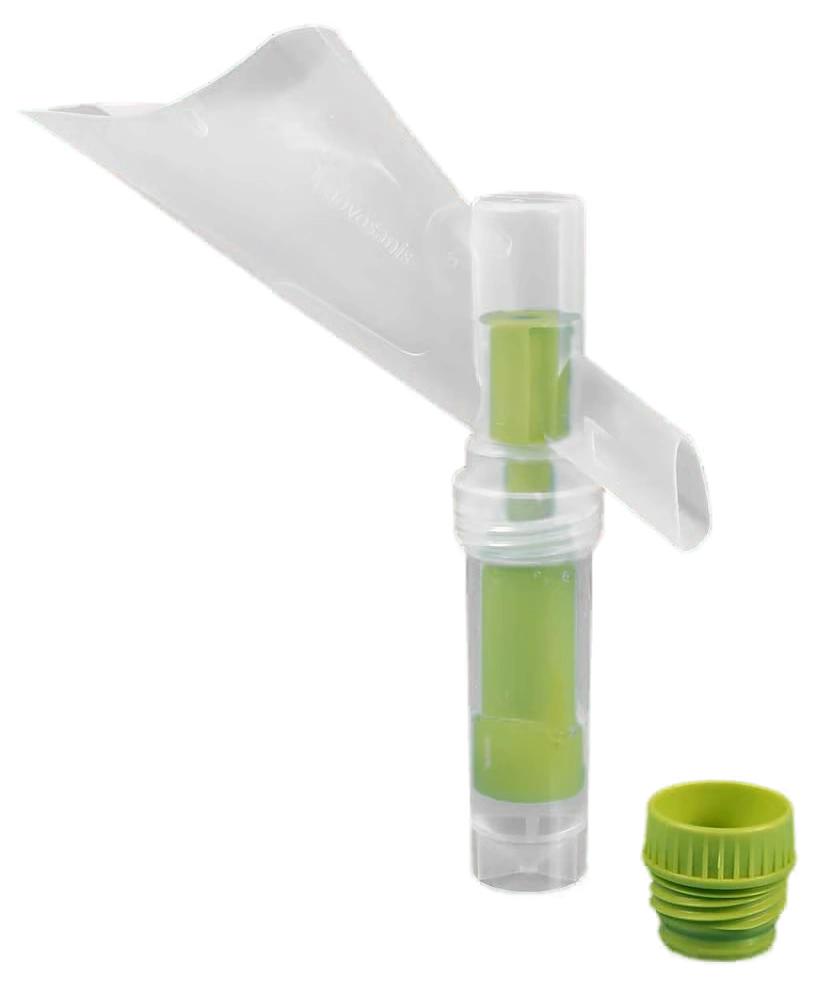
Colli-Pee is an all-in-one first-void urine collector: a diverter directs the very first part of the urine stream into a tube that fills to a defined volume and stops, so every sample is the same standardised first-catch fraction rather than an uncontrolled random catch. The tube can be neat or prefilled with a DNA/analyte-conservation medium that stabilises the sample for ambient transport, and is available across a range of collection volumes. Humans Nexus curates and supplies the device on its platform; DNA Genotek is the legal manufacturer; the device was invented by Novosanis, and both are OraSure companies.
In the maker’s own figures, first-void is the first 20 to 30 mL of the stream, typically the first 20 mL; collectors come in 4, 10, 20 and 40 mL, and the Urine Conservation Medium, at one part to three of sample, holds DNA for 7 days at room temperature, 14 days at 4 °C and up to 90 days frozen. Colli-Pee is CE-marked, its conservation-medium configurations CE-IVD marked, a US FDA Class 1 device, with research-use variants labelled as such.
The first catch carries the signal.
For urogenital targets, where in the stream you collect changes what you measure. The first-void fraction flushes cells and analytes shed from the urethra and lower genital tract, so it concentrates the signal that a random midstream sample dilutes. Standardising both which fraction and how much is collected is what makes urine a reproducible molecular matrix, the basis for the HPV, STI and biomarker evidence below.
What the record shows.
Each figure below belongs to the study that produced it. Colli-Pee is named where the paper’s abstract names it; the rest prove the first-void matrix the device standardises.
Method validation runs per assay before a result is reported. The full reading list follows below.
Catch. Stabilise. Return.
The patient starts urinating into the device; the diverter routes the first-void fraction into the collector.
The tube fills to its defined volume and, where used, mixes the sample with a conservation medium.
Cap and drop it in the tracked mailer, chain of custody from the first second.
Assembled into a kit.
Colli-Pee is curated onto the platform and assembled into a regulated Humans Nexus collection kit: device, conservation medium where the assay requires it, tamper-evident return packaging and app-guided instructions, under its own UDI.
For urogenital molecular work.
Good to know.
What does Colli-Pee collect?
A standardised, defined volume of first-void urine, the first 20 mL of the stream, the fraction richest in urogenital cells and analytes, captured by a diverter rather than a random midstream sample.
Why first-void rather than midstream urine?
For urogenital targets such as HPV and STIs, the first-void fraction concentrates the cells and analytes shed from the lower genital tract that a midstream sample dilutes, which is why it is the preferred molecular matrix.
Which volumes does Colli-Pee come in?
4, 10, 20 and 40 mL collectors, per the maker. The first 20 mL is the fraction that matters; the assay sets the volume, and in Colli-Pee tubes of 4, 10 and 20 mL the DNA extraction method changed the yield more than the volume did.
How long is the sample stable?
With the conservation medium, DNA for 7 days at room temperature, 14 days at 4 °C and up to 90 days frozen, per the maker; neat urine follows the laboratory’s rule for the assay.
Is first-void urine validated for HPV screening?
In the VALHUDES study, high-risk HPV testing on Colli-Pee first-void urine reached a relative sensitivity of 0.95 and a relative specificity of 1.03 for high-grade cervical precancer against clinician-taken cervical samples, with a validated assay and cut-off.
Can it be used at home for STI testing?
Yes. In 213 men sending 473 Colli-Pee samples by regular post, home first-void urine agreed with clinic urine at kappa 0.75 for chlamydia, 0.87 for gonorrhoea and 0.85 for Mycoplasma genitalium.
What is its regulatory status?
Colli-Pee is CE-marked, its conservation-medium configurations are CE-IVD marked and it is a US FDA Class 1 device, per the manufacturer; research-use variants are labelled as such. Device-level regulatory status is held by DNA Genotek; Humans Nexus assembles the regulated kit around it and validates the method per assay before patient-facing reporting.
Who is the manufacturer?
DNA Genotek is the legal manufacturer; the device was invented by Novosanis, and both are OraSure companies. Humans Nexus curates and supplies it on the platform and assembles the kit around it.

Library Colli-Pee
Evaluating DNA methylation markers and extended HPV genotyping in first-void urine for detecting high-grade cervical lesions in HPV-positive women: a cross-sectional study
Read in the LibraryAgreement and Diagnostic Performance of Urinary HPV Testing Versus Clinician-Collected Cervico-Vaginal Sampling: A Prospective Cross-Sectional Study in a Romanian Cohort
Read in the LibraryThe importance of first-void urine for assessing HPV-specific antibodies: A comparison with midstream urine
Read in the LibraryAccuracy of HPV Testing Using Self-collected Urine Compared With Physician-collected Cervical Specimen for HSIL or Worse
Read in the LibraryComparison of three different hpv self-sampling tools - a subanalysis of the prospective, randomized hannover self-collection study
Read in the LibraryEvaluation of the Quality and Suitability of Self-Collected Vaginal and Urine Samples for Human Papillomavirus Testing: A Prospective Matched Study
Read in the Library
One free account opens every finding in the OpenSampling Library. The same account signs you in to Pulse.
These citations describe the published evidence for the collection formats and devices, not claims about specific Humans Nexus assays, which are validated per analyte and per laboratory.
Put first-void urine on your platform.
Talk to us about Colli-Pee for your HPV, STI or biomarker programme.