Urine microsampling,
liquid and dried.
Urine, self-collected at home across the whole ladder: a standardised first-void fraction with Colli-Pee for HPV and sexually transmitted infections, dried urine for economical hormone-metabolite panels, and VAMS by Neoteryx Mitra where a fixed volume and room-temperature stability matter, for hormone, steroid, drug and renal markers, returned to an accredited laboratory under chain of custody.
What is urine
microsampling?
Urine microsampling is the collection of a defined urine sample by the patient, at home or at the point of care, and its return to an accredited laboratory under documented chain of custody: a standardised first-void fraction for molecular targets, a first-morning or timed liquid collection, or a dried format, a spot on a card or a fixed volume on a VAMS tip, that ships at ambient temperature. It is the microsampling model applied to urine: patient-collected, small-format, tracked through the platform. The industry also calls it urine self-sampling, home urine collection or, for HPV and STI work, first-void urine self-collection.
Three ways to collect urine.
Conventional urine depends on voided volume, cold-chain shipping and preservatives. Dried formats remove most of that burden by absorbing a small aliquot that dries and ships ambient. Of the dried options, VAMS is the one that also fixes the volume.
| Liquid urine | Dried urine spot | VAMS | |
|---|---|---|---|
| Format | Voided or timed collection | Drops dried on a card | Fixed volume on a tip |
| Volume control | Full sample | Uncontrolled spot | Fixed at the tip, viscosity-independent |
| Cold chain | Refrigerate or preserve | Ambient | Ambient |
| Ambient stability | Limited, degrades in transit | Good | Best, outperforms DUS on long storage |
| Best-established use | First-void molecular, HPV and STI; high-volume and biobank | Economical dried panels | Volumetric accuracy & stability |
| Device on the platform | Colli-Pee for first-void; a cup for timed collections | Filter-paper card | Neoteryx Mitra tip |
Drying urine at the point of collection halts the bacterial and thermal degradation that affects wet urine in transit. In a direct side-by-side on the same urine, VAMS held long-term room-temperature stability better than a dried urine spot, recovering more than 82% of anabolic steroids after a year against 70% from the spot, which is why we make VAMS the volumetric dried choice.
First-void, by Colli-Pee.
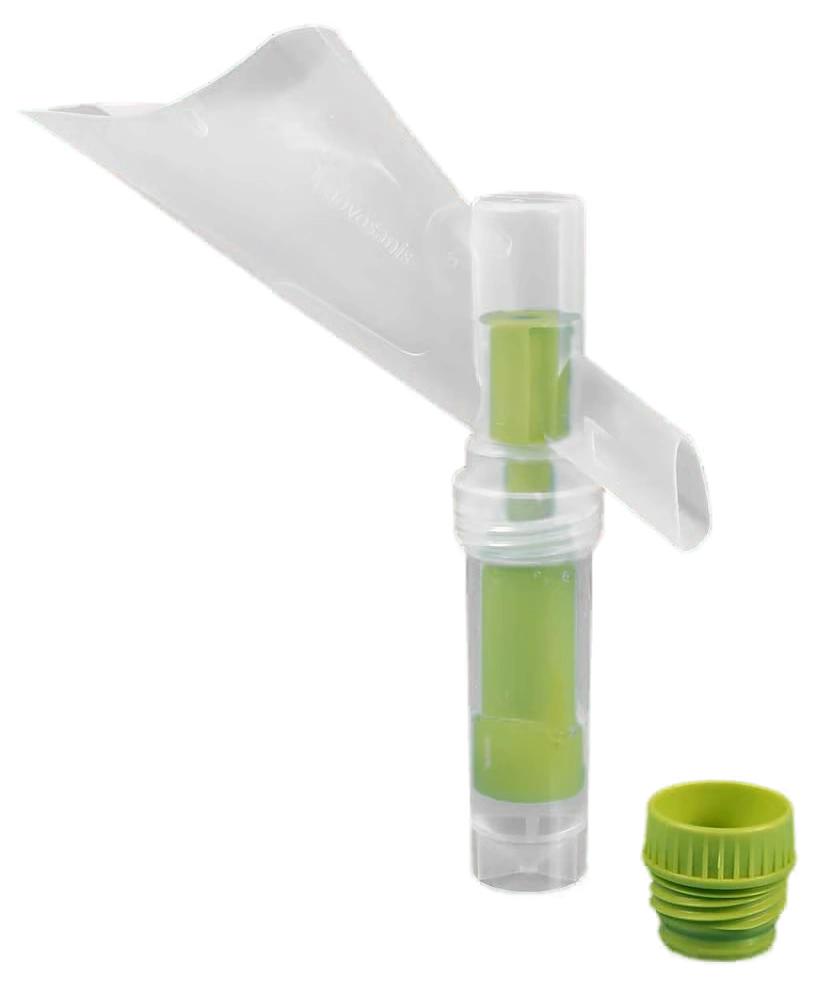
Not all liquid urine is equal. For urogenital molecular targets, high-risk HPV, chlamydia, gonorrhoea, Mycoplasma genitalium and related biomarkers, the first-void fraction, the first millilitres of the stream, concentrates the cells and analytes that a random midstream sample dilutes. Colli-Pee captures a standardised, defined volume of that fraction into a tube that can be prefilled with a conservation medium, which is what makes liquid urine a reproducible molecular matrix at home. In the VALHUDES study, high-risk HPV testing on Colli-Pee first-void urine was as sensitive for high-grade cervical precancer as clinician-taken cervical samples, relative sensitivity 0.95 and relative specificity 1.03, and at-home Colli-Pee collection agreed with clinic urine for chlamydia, gonorrhoea and Mycoplasma genitalium at kappa 0.75, 0.87 and 0.85. Colli-Pee is CE-marked, CE-IVD in its stabilised configuration; DNA Genotek is the manufacturer.
VAMS, by Neoteryx.
After blood, urine is the most applied matrix for volumetric absorptive microsampling in forensic work. The Neoteryx Mitra tip wicks a fixed volume regardless of the sample’s viscosity, dries, and ships ambient, giving a quantitatively consistent dried urine sample without a cold chain: on the same urine, a Mitra tip kept more than 82% of anabolic steroids after a year at room temperature against 70% for a dried spot, and a 237-substance, 11-class anti-doping screen now runs on Mitra tips as well as on cards. Humans Nexus curates and supplies the device on the platform and assembles the regulated kit around it; Neoteryx is the manufacturer.
Urine VAMS is positioned for hormone and steroid panels, drug/adherence and metabolite work, not for immunosuppressant therapeutic drug monitoring, which is a blood assay. Suitability is established per analyte through method validation.
A validated panel.
An honest trade-off.
Dried is not universally better; it is a logistics choice. Dried VAMS and DUS win on transport, room-temperature storage, biohazard handling and volumetric consistency; they suit hormone, steroid, drug and metabolite work collected from home. Liquid urine keeps an edge where you need large volumes, ultra-low-abundance analytes, or an established frozen-biobank workflow, many clinical-chemistry parameters remain valid for years frozen without preservative. We offer the whole ladder and match the format to the analyte, not the other way round.
From collection to lab.
A first-void fraction into the Colli-Pee, a first-morning or timed sample into a preserved container, a few drops onto a dried-urine card, or a fixed volume onto a Mitra tip, matched to the panel.
Sealed and ID-matched, the kit returns by tracked courier: dried and VAMS formats at ambient temperature, preserved first-void urine by regular post as validated, and controlled-temperature transport only where a liquid panel requires it.
The laboratory accessions the sample under the same chain of custody, and the result returns through the platform into your system.
What the record shows.
Each figure below belongs to the study that produced it. A device is named only where the paper’s abstract names it.
Method validation runs per analyte and per format before a result is reported. The full reading list follows below.
Sealed. Tracked.
Ambient-stable.
Preservative-stabilised liquid collection, dried-urine cards and VAMS tips are matched to each panel’s validated requirements, sealed and tracked end to end. Dried and volumetric formats ship ambient; liquid uses controlled-temperature transport where the panel requires it. Every kit is ID-matched and sealed, its UDI bound to a chain of custody at activation and tracked by courier scan to accessioning. Method validation runs into ISO 15189-accredited laboratories before patient-facing reporting.
What’s in the box.
Urine | Cell
- Colli-Pee first-void collector, or a preserved cup for timed collections
- Dried-urine card or Neoteryx Mitra tips, matched to the panel
- ID-matched, tamper-evident seal
- Tracked return packaging, ambient for dried and preserved formats
- Guided collection in Flow, step by step
Whoever runs the test.
Infrastructure for healthcare and life sciences. Our partners reach the patient, and we never sell directly.
Good to know.
Why dried or volumetric urine instead of liquid?
Dried formats ship at ambient temperature without refrigeration and halt the degradation that affects wet urine in transit. VAMS adds a fixed, viscosity-independent volume for quantitation. Liquid still suits high-volume, ultra-low-abundance or established frozen-biobank work; it is a trade-off matched to the analyte.
Why VAMS rather than a dried urine spot?
Both dry and ship ambient, but VAMS fixes the collected volume at the tip and, in a direct comparison on the same urine, held long-term room-temperature stability better than a dried urine spot, more than 82% recovery of anabolic steroids after a year against 70%, so it is our volumetric dried choice where accuracy and storage matter.
What can urine microsampling measure?
High-risk HPV, chlamydia, gonorrhoea and Mycoplasma genitalium on a standardised first-void fraction; hormone and steroid metabolites, reproductive markers, drug and adherence testing and multi-class doping panels on dried urine; renal and metabolic markers such as albumin-to-creatinine ratio on liquid urine. Not immunosuppressant TDM, which is a blood assay.
Which urine collection devices do you use?
Colli-Pee by DNA Genotek for a standardised first-void fraction, Neoteryx Mitra tips for volumetric dried urine, and filter-paper cards for dried urine spots, each assembled into the regulated kit with the preservative or medium the panel needs.
Is first-void urine as good as a cervical sample for HPV screening?
In the VALHUDES study, high-risk HPV testing on Colli-Pee first-void urine was as sensitive for high-grade cervical precancer as clinician-taken cervical samples, relative sensitivity 0.95 and relative specificity 1.03, with a validated assay and cut-off. It is the route for women who do not attend for a cervical sample.
Can STI testing be done on urine collected at home?
Yes. In 213 men sending 473 Colli-Pee samples by regular post, home first-void urine agreed with clinic urine for chlamydia, gonorrhoea and Mycoplasma genitalium at kappa 0.75, 0.87 and 0.85.
Does the collected volume matter?
Colli-Pee fixes the first-void volume, which is the point. Across 27,042 first-void specimens, over-collection did not change chlamydia or gonorrhoea positivity, and in Colli-Pee tubes of 4, 10 and 20 mL the DNA extraction method mattered more than the volume: capture the first fraction, then standardise the processing.
Does it need a cold chain?
Dried and VAMS formats do not; preserved first-void urine travels by regular post as validated; other liquid collections use preservatives and controlled-temperature transport where the panel requires it.

Library Urine microsampling
Every paper read and summarised in our own words, each on a page of its own in the OpenSampling Library.
Newest
Diagnostic Performance of HPV Testing Using Self-Collected Urine and Vaginal Samples for Detecting Cervical Precancer or Worse: A Meta-Analysis
Read in the LibraryEvaluating DNA methylation markers and extended HPV genotyping in first-void urine for detecting high-grade cervical lesions in HPV-positive women: a cross-sectional study
Read in the LibraryComparative efficacy, feasibility and acceptability of HPV DNA testing on first-void urine versus self-collected vaginal samples: a real-world study in a resource-limited setting
Read in the LibraryComparison of self-collected vaginal swabs and first-void urine for detection of human papillomavirus in sexually active girls and women in three South Asian countries
Read in the LibraryHPV detection in first void urine and cervicovaginal samples: comparative study and analysis of associated factors in women from tunja, colombia
Read in the LibraryComparative performance of first-void urine and self-collected vaginal swabs against clinician-collected cervical samples using 2 HPV real-time assays in Indian women
Read in the Library
First-void urine
Diagnostic Performance of HPV Testing Using Self-Collected Urine and Vaginal Samples for Detecting Cervical Precancer or Worse: A Meta-Analysis
Read in the LibraryEvaluating DNA methylation markers and extended HPV genotyping in first-void urine for detecting high-grade cervical lesions in HPV-positive women: a cross-sectional study
Read in the LibraryComparative efficacy, feasibility and acceptability of HPV DNA testing on first-void urine versus self-collected vaginal samples: a real-world study in a resource-limited setting
Read in the LibraryComparison of self-collected vaginal swabs and first-void urine for detection of human papillomavirus in sexually active girls and women in three South Asian countries
Read in the LibraryHPV detection in first void urine and cervicovaginal samples: comparative study and analysis of associated factors in women from tunja, colombia
Read in the LibraryComparative performance of first-void urine and self-collected vaginal swabs against clinician-collected cervical samples using 2 HPV real-time assays in Indian women
Read in the Library
Liquid
The potential use of midstream urine samples for diagnosing Chlamydia/Gonorrhoea NAAT in male and female patients, and the pre-analytical storage conditions in neat urine specimens
Read in the LibraryAgreement between INDICAID™ HPV (human papillomavirus) Urine Test and BD Onclarity™ HPV Assay in detection of high-risk HPV in self-collected urine samples
Read in the LibraryIntegrating Microsampling in Human Biomonitoring: Methodologies, Regulatory Frameworks, and Case Study Insights
Read in the LibraryA Noninvasive Method for Dynamic Ovulation Monitoring Based on Memristor
Read in the LibraryIntegrated Methylation and Copy Number Analysis for Noninvasive Bladder Cancer Detection in Urine
Read in the LibraryApplication of PathoChip to urine-derived nucleic acids for broad microbial profiling in men with suspected prostate cancer: setup of a methodological workflow and pilot feasibility study
Read in the Library
Dried
Volumetric absorptive microsampling device for forensic Toxicologic screening: A case report as proof-of-concept
Read in the LibraryEvaluation of the Quality and Suitability of Self-Collected Vaginal and Urine Samples for Human Papillomavirus Testing: A Prospective Matched Study
Read in the LibraryPrevalence of chlamydial, gonococcal and syphilis positivity by anatomical site and sex via self-collected biospecimens using at-home testing kits among a large and diverse cohort of men and women enrolled in the MACS/WIHS Combined Cohort Study (MWCCS) in the USA
Read in the LibraryDevelopment and evaluation of dried urine strip for genital chlamydia and gonorrhea testing
Read in the LibrarySerial Dried Blood Spot C-Peptide Sampling, but Not Urine C-Peptide-to-Creatinine Ratio, Detects Early Preservation of β-Cell Function in New-Onset Type 1 Diabetes: Experience From the USTEKID Trial
Read in the LibraryComprehensive at-home sexually transmitted and blood borne infection (STBBI) testing program: A pilot study
Read in the Library
VAMS
Volumetric absorptive microsampling device for forensic Toxicologic screening: A case report as proof-of-concept
Read in the LibraryEvaluation of oral fluid microsampling as a urine surrogate matrix in substance use disorder care: clinical applicability and analytical performance
Read in the LibraryMass Spectrometry-Based Anti-Doping Analysis: A Critical Review of Emerging Analytical and Sample Pretreatment Strategies
Read in the LibraryLC-HRMS screening for 11 classes of prohibited substances in dried urine spots for doping control
Read in the LibraryDerivation of Human Toxicokinetic Parameters and Chemical-Specific Adjustment Factor of Citrinin Through a Human Intervention Trial and Hierarchical Bayesian Population Modeling
Read in the LibraryVolumetric Absorptive Microsampling in Toxicology
Read in the Library
One free account opens every finding in the OpenSampling Library. The same account signs you in to Pulse.
These citations describe the published evidence for the collection formats and devices, not claims about specific Humans Nexus assays, which are validated per analyte and per laboratory.
Put urine on the platform.
Talk to us about adding liquid, dried and volumetric urine collection to your programme.