Knock knock.
Collection comes home.
Remote sampling, bought as a platform: regulated kits, clinical-grade logistics, verified identity, sample tracking and accredited laboratories, orchestrated as one. The way a procurement team buys remote sampling for a programme or a decentralised clinical trial, without building any of it.
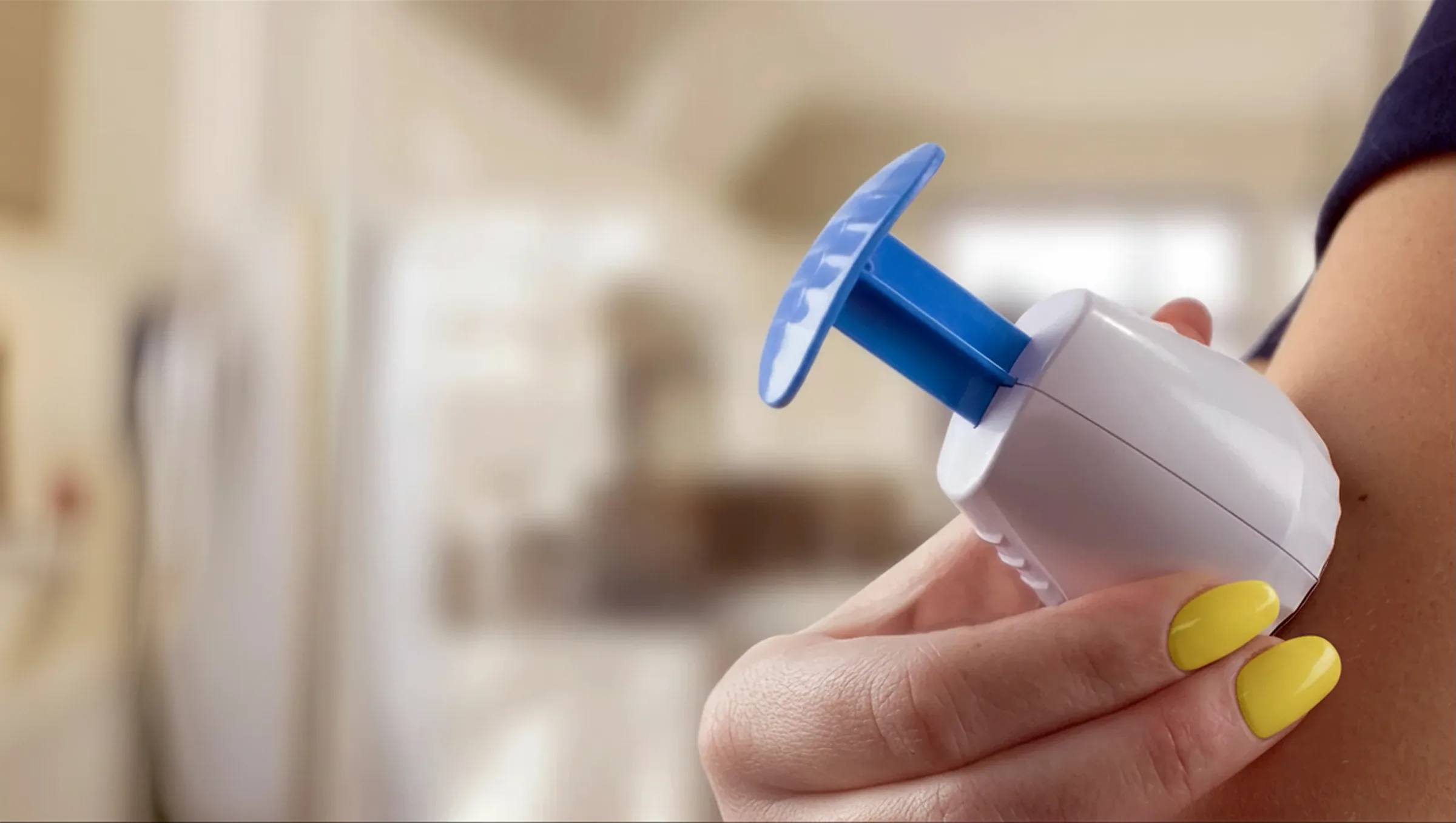
On your own arm,
on your own terms.
No waiting room, no phlebotomist, no one else’s clock; a clinical-grade sample now takes a few calm minutes at the kitchen table. Everything that makes it trustworthy travels with it: the regulated kit, the sealed chain of custody, the accredited laboratory. Only the clinic stays behind.
The at-home setting.
The patient self-collects with guided capture, and the sample returns by the same route as point-of-care collection: same kits, same custody, same accredited labs.
The clearest at-home story is fertility hormone monitoring →: adults self-collecting through a treatment cycle, no clinic queue and no lancet. Children are collected under supervision, at the point of care.
Infrastructure for remote sampling.
Remote sampling is the collection of clinical specimens away from a clinic: capillary blood, saliva, urine and stool, self-collected by the patient at home, home sampling or self-sampling in other names, and returned to an accredited laboratory under documented chain of custody. Humans Nexus is the infrastructure underneath it: the regulated kit, the logistics that protect the sample in transit, the identity and custody record that travel with it, and the platform that lands structured results in the laboratory.
It is one platform, and it is independent. We integrate accredited laboratories and route work into them, we own no laboratory and we never compete with the labs we serve. Partners reach the patient; we never sell directly.
Four parts, one platform.
Everything a remote-collection programme needs to be clinical-grade rather than mail-in: assembled, regulated and operated as one supply.
The fourth part is the destination: ISO 15189-accredited laboratories, integrated through our lab network, never displaced by it.
Tracked from the doorstep to the bench.
A remote sample is only worth analysing if you can say where it has been. Activating the kit binds its UDI to a chain of custody, and every hand-off is timestamped from there: dispatch, activation, collection, sealing, each courier scan, and accessioning at the laboratory. The patient follows the sample in Flow the way they would track a parcel; the programme sees every kit and every sample in Pulse, with a temperature trace wherever the assay required one; and the result returns along the same record, so a sponsor, a laboratory or an auditor can read the whole journey of any sample, months later.
From site-centric to remote-first.
Diagnostics and trials were built around the site. The patient travels to a clinic, a phlebotomist draws a venous tube, and the sample enters the laboratory through a single physical door. That door is the bottleneck: it limits who can be tested, how often, and how far from a major centre, and every missed visit is a missed data point.
Collection happens only where there is a clinic and a phlebotomist. Reach, frequency and adherence are all capped by the visit.
The kit goes to the patient. Collection happens at home, on a regulated pack, and the sample returns under documented custody.
Specimens still land in an accredited laboratory, now without the geography, the travel or the missed appointment.
Remote-first does not lower the standard. The accredited laboratory, the custody chain and the regulatory status all stay in place; the clinic visit is what moves. See the collection model →
What patients did with it. In a 2022 study in RMD Open, 70 patients with immune-mediated rheumatic diseases self-collected upper-arm capillary blood with two press-activated devices, the YourBio TAP II among them. Autoantibody results agreed with venous samples in 94.7% of positives and 99.5% of negatives, 98.6% of patients collected enough blood within two attempts, and most found it less painful than venepuncture; 62.9% said they would choose the TAP II over a venous draw. The full evidence base is in our research library.
Infrastructure, not a lab.
A procurement team buying remote sampling does not want to be locked to one laboratory’s menu, or to a vendor that competes with its own partners. Our position is deliberately independent: we provide the platform and integrate the laboratory you choose, so the relationship with the patient and the result stays with you.
Whoever procures collection.
See how the platform maps to each programme on solutions.
Good to know.
What is remote sampling?
The collection of clinical specimens away from a clinic: capillary blood, saliva, urine and stool, gathered by the patient at home and returned to an accredited laboratory under documented chain of custody. The same model is called home sampling, self-sampling or patient-centric sampling depending on who is describing it; the distinction that matters is not the name but whether the sample arrives clinical-grade. Procurement teams often describe it as remote specimen collection.
What is remote sampling in clinical trials?
The collection of a participant’s samples away from the investigator site, at home or at a local point of care, on a regulated kit under documented custody, so a decentralised or hybrid trial keeps its sampling schedule without the site visit; the sample-return record is what a sponsor or CRO shows an auditor.
How is this different from a consumer mail-in test?
A mail-in test drops a sample in the post. Clinical-grade remote sampling means a regulated collection pack, ID-matched tamper-evident sealing, documented custody and controlled-temperature transport where the assay requires it, into an accredited laboratory, not a consumer service.
How is a remote sample tracked?
From kit activation, when the pack’s UDI binds to a chain of custody, through every timestamped hand-off, courier scan and temperature trace, to accessioning at the laboratory; the patient follows it in Flow, the programme in Pulse.
Do you run the laboratory?
No. We are independent infrastructure. We integrate ISO 15189-accredited laboratories and route specimens into them; we own no laboratory and never compete with the labs we serve.
Does remote collection always need a cold chain?
No. Dried and buffered formats ship at ambient temperature by design. Controlled-temperature transport is the managed exception, applied only where the assay requires it.
Who owns the patient relationship?
Our partners do. Partners reach the patient and we never sell directly. Personal data is handled GDPR-natively throughout.
Buy remote sampling as a platform.
Talk to us about putting regulated kits, clinical-grade logistics and accredited-lab integration behind your programme.