The first blood test,
without the first tear.
Every parent knows the sound of needle fear: the gripped sleeve, the night-before dread. For children, and for anyone with needle phobia or a learning disability, the venepuncture chair is where healthcare breaks down. Pediatric microsampling rewrites the scene: a small touch-activated device on the upper arm, applied by a healthcare professional, a halo of microneedles, not a blade. No white knuckles. No held-down child. A blood test that ends in a sticker, not a tear.
Small veins, big fear.
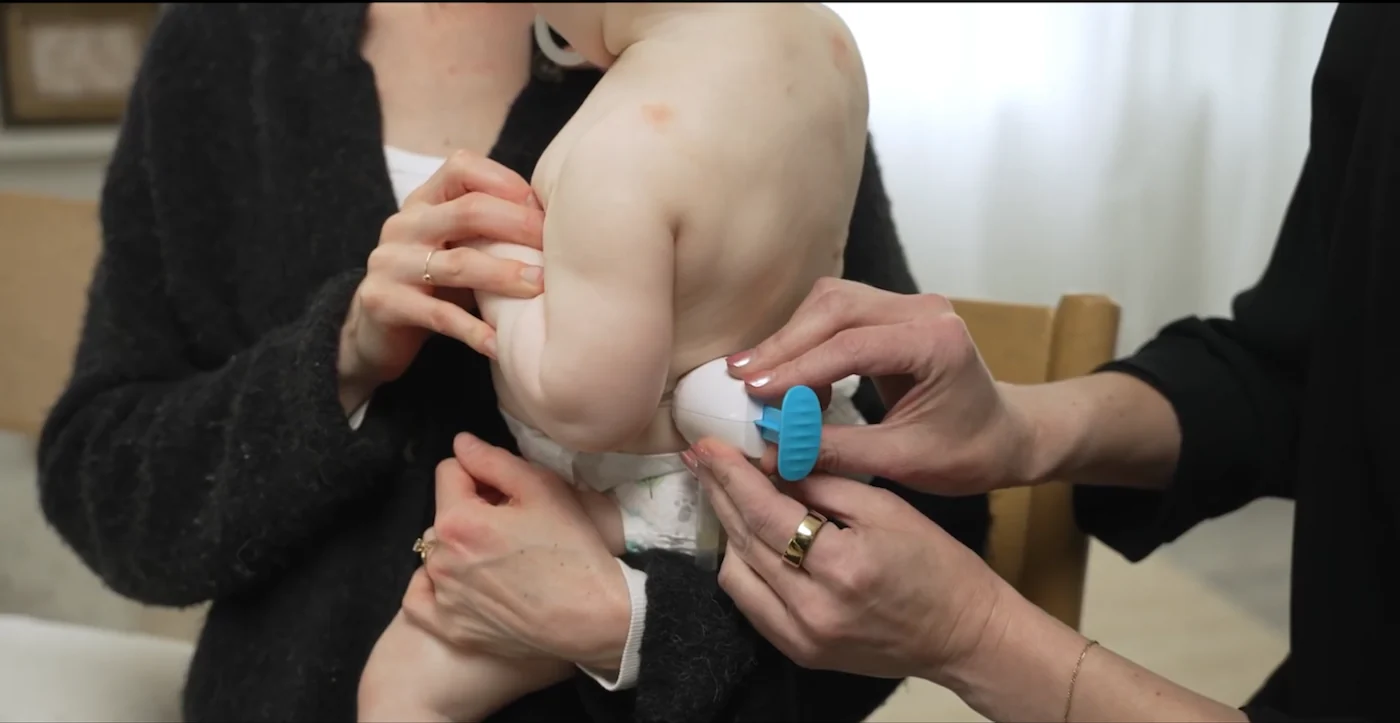
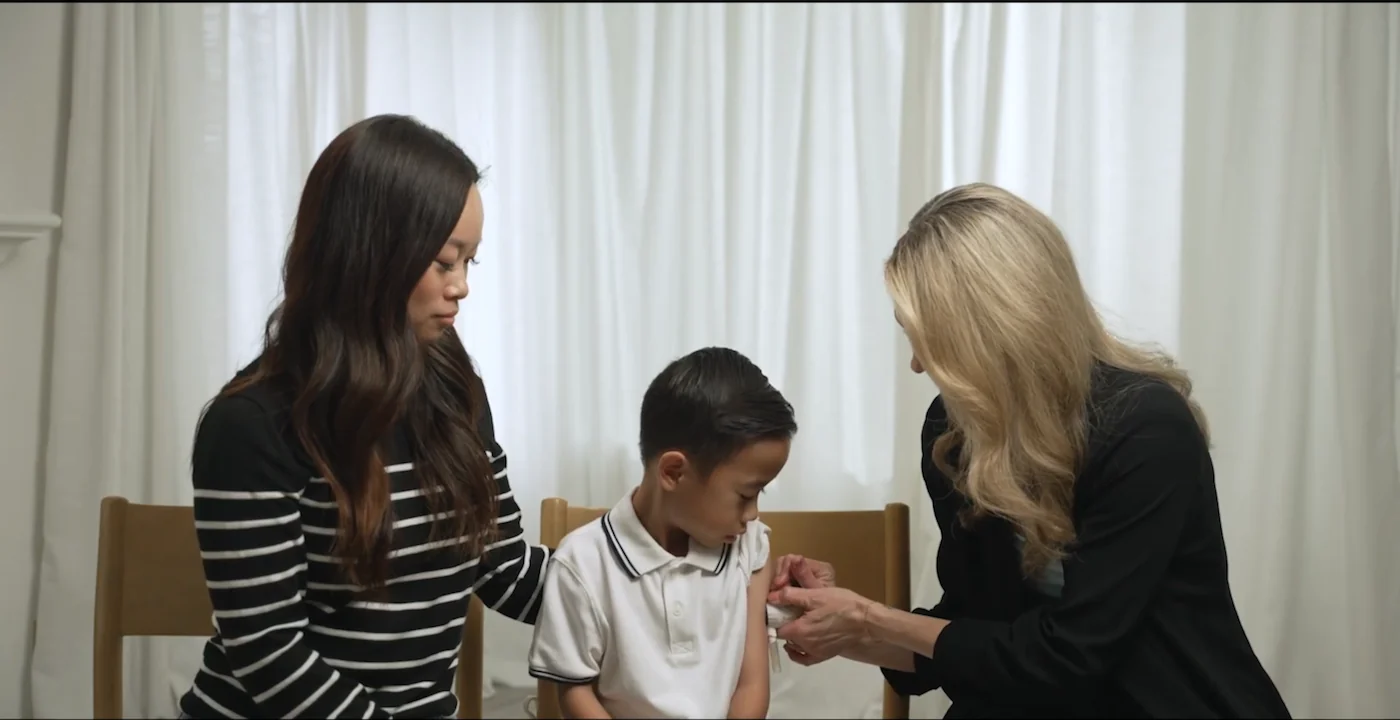
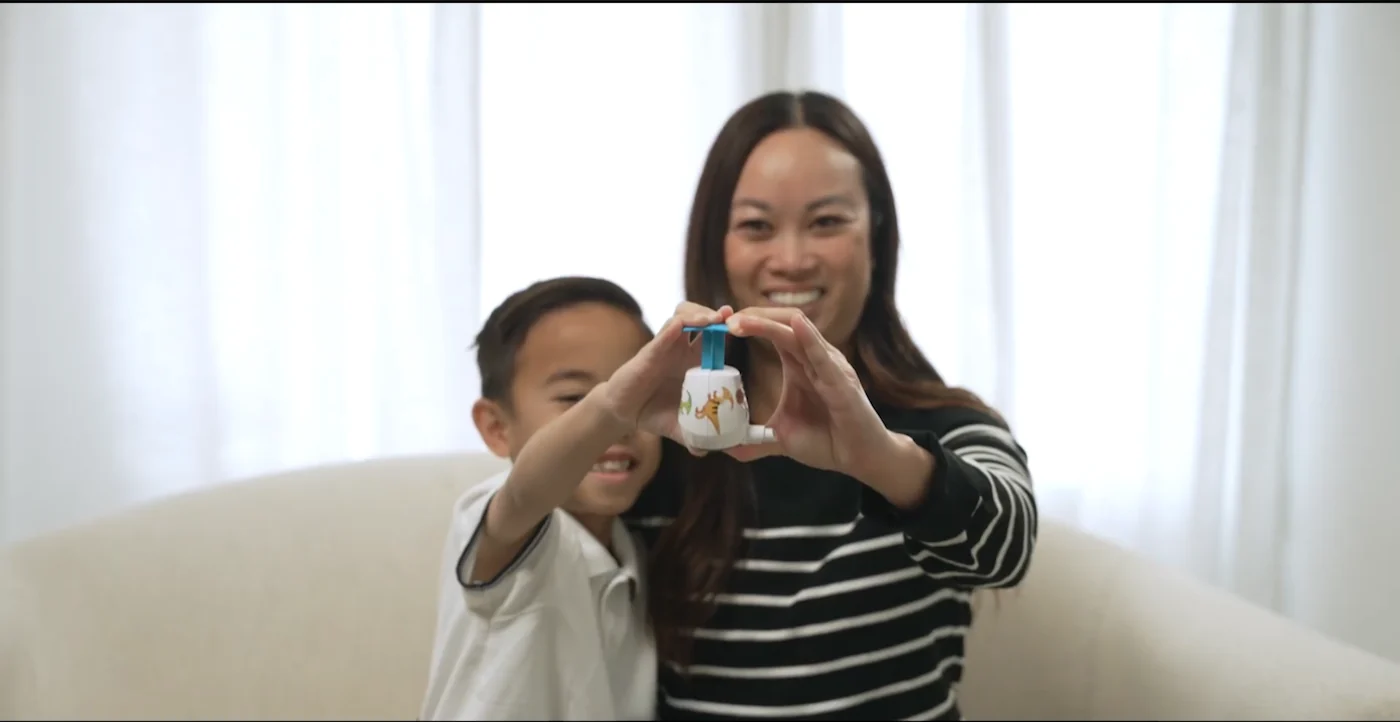
A child doesn’t remember the diagnosis. They remember being held down. Pediatric venipuncture fails where it hurts most: small veins mean repeat attempts, repeat attempts mean restraint, and restraint teaches a child that medicine is something done to them. So parents postpone the next test, and the clinical picture goes blank exactly where growing bodies change fastest.
Stickers on, fear off.
The platform’s answer is YourBio TAP, touch-activated and applied to the upper arm, a halo of microneedles, not a blade. In a peer-reviewed study, most participants preferred it to a needle, 63% versus 7%. The children decorate the device with stickers before it goes on, a healthcare professional applies it with the parent right there, and the sample is done before the fear has anywhere to start. For infants, collection is demonstrated from the thigh, held in a parent’s arms. In children the device is used under healthcare-professional supervision; at-home self-collection is for adults.
“Great fun,” said Abi.
About a blood test.
Abi is fifteen. She has Down’s syndrome, and her thyroxine treatment needs regular blood monitoring, which for years meant everything a needle means to a frightened teenager. Then University Hospitals of Morecambe Bay NHS Foundation Trust became the first NHS trust to offer TAP collection for people with learning disabilities, in a programme led by Karen Perkins, Principal Clinical Scientist. Since April 2025 the team has collected samples from nearly fifty patients who previously could not give blood at all, and six more NHS trusts have asked for their data to replicate the model.
“TAP really is a game changer for Abi, and I’m sure many others like her.”
Abi’s mother · University Hospitals of Morecambe Bay NHS Foundation Trust“The fear of your child dying never goes away. Now I know I can keep her well.”
Lucy’s mother · Lucy, 16, has Down’s syndrome and autism · University Hospitals of Morecambe Bay NHS Foundation TrustAbigail's StoryBlood Sciences, University Hospitals of Morecambe Bay NHS Foundation Trust · 5:09
Nothing loads from YouTube until you press play: no third-party request, no cookie, before that. The film is Blood Sciences, University Hospitals of Morecambe Bay NHS Foundation Trust’s, not ours. Watch it on YouTube →
Read the story at the Royal College of Pathologists · the Trust’s announcement
Quotes and figures from the Royal College of Pathologists and University Hospitals of Morecambe Bay NHS Foundation Trust. TAP is the YourBio device curated on the Humans Nexus platform; the Morecambe Bay programme is the Trust’s own work. Pediatric microsampling and paediatric microsampling are the same practice, the American and British spellings of one idea.
Not a promise. A record.
We won’t ask you to take virtually painless on faith or put a stronger word in anyone’s mouth: what follows comes from independent, peer-reviewed research and the clinicians who use it, and every paper is in our research library. In an Oxford trial published in Diabetes Care, 63% of participants, children and adults, preferred the device to a needle and just 7% preferred the needle; Oxford judged it a reliable, highly accurate alternative to a venous draw, with far less post-collection bruising, about 6% versus 35% after a needle. At Massachusetts General Hospital, published in JAMA, it drew blood from infants as young as two months, chosen to avoid a painful heel prick.
“We are using a microneedle sticker device that collects surface capillary blood from the babies in order to avoid a painful heel prick/venipuncture.”
Edlow Lab · Massachusetts General Hospital · edlowlab.orgThese are independent studies of the YourBio TAP device that Humans Nexus curates on its platform, not our own trials; the maker supplied the devices but, per the papers, had no role in their design or analysis. On the Humans Nexus platform, children are collected under healthcare-professional supervision; the at-home collections above were conducted within IRB-approved research protocols.
For the children who need it often.
The lancet-free upper-arm draw is one path. For a child with a chronic condition, a transplant, an autoimmune disease, who needs a drug level checked again and again, the platform also offers the Neoteryx Mitra device: a fixed-volume dried-blood microsample from a single fingertip, taken at home instead of a repeat venous draw. A different tool for a different job, quantitative drug monitoring, and the evidence in children is real.
Validated in children for transplant immunosuppressants and antifungal drug levels. The Mitra device on the platform →

Library VAMS in children
Peer-reviewed evidence for volumetric absorptive microsampling (VAMS) in pediatric drug monitoring: at-home tacrolimus after transplant, antifungal levels, and the honest limits. Every paper opens its page in the OpenSampling Library, with a link to an open-access copy where one exists.
Cefepime pharmacokinetics in critically ill children with multiple organ dysfunction syndrome using volumetric absorptive microsampling
Read in the LibraryVolumetric Absorptive Microsampling (VAMS) for Therapeutic Drug Monitoring of Antiseizure Medications (ASMs) in Pediatric Patients
Read in the LibraryAnalytical validation of a dried blood microsampling method to measure androstenedione, 17α‑hydroxyprogesterone, and 11‑ketotestosterone for congenital adrenal hyperplasia monitoring
Read in the LibrarySystematic evaluation of propofol population pharmacokinetic models and development of a literature-supported new meta-model for critically ill preterm and term neonates
Read in the LibraryDevelopment and application of an LC-MS/MS method for 8 antiepileptic drugs and 2 metabolites using microsampling techniques (DBS and VAMS)
Read in the LibraryRapid, robust LC-MS/MS quantification of cefazolin in whole blood microsamples, plasma, and plasma ultrafiltrate: Analytical method validation and preliminary clinical application in pediatric population
Read in the Library
One free account opens every finding in the OpenSampling Library. The same account signs you in to Pulse.
These citations describe the published evidence for the collection formats and devices, not claims about specific Humans Nexus assays, which are validated per analyte and per laboratory.
A clinician’s hands, a guided Flow.
For children, collection happens under healthcare-professional supervision: at the practice, on the ward, at the point of care or on a supervised home-nursing visit. Flow carries the record: identity attested, consent recorded by the parent or guardian, collection confirmed. From there the sample follows the same route as every other, clinical courier pickup, documented chain of custody, an accredited laboratory, and the result returns to the pediatrician and the family under the programme’s release policy. At-home self-collection with YourBio is for adults.
You stay in the room. The stickers are her job; the rest is ours.
Pediatric care, finally seen.
Good to know.
Is there a needle-free blood test for children?
Not needle-free, but there is no lancet and no venepuncture, which is the distinction that matters to a frightened child. TAP collects from the upper arm through a halo of microneedles rather than a blade: nothing to watch go in, and no fingertip squeeze. Applied by a healthcare professional, it draws a real whole-blood sample the laboratory runs like any other. It’s decorated with stickers before it goes on, and in published studies most participants preferred it to a needle.
Is it really virtually painless for children?
The evidence is independent. In an Oxford trial published in Diabetes Care, most participants, children and adults, preferred it to a needle, 63% against 7%, and Oxford judged it a reliable, highly accurate alternative. At Massachusetts General Hospital, clinicians use it on infants specifically to avoid a painful heel prick. In the NHS programme, Abi called it great fun. There is no lancet, no visible needle and no venepuncture.
Does it work for needle phobia or learning disabilities?
That is where it has proven itself most. University Hospitals of Morecambe Bay NHS Foundation Trust, the first NHS trust to offer TAP for people with learning disabilities, has collected from nearly fifty patients since April 2025 who previously could not give blood at all, and other trusts are adopting the model.
What ages can use it?
The manufacturer demonstrates use across ages: upper-arm collection for children and adults, and thigh collection for infants held by a parent. In children the device is used under healthcare-professional supervision; adults may self-collect at home. Suitability for a specific programme and age group is confirmed per protocol with the laboratory.
Who collects the sample?
For children, a healthcare professional, at the practice, the point of care or a supervised visit, with the parent alongside and consent recorded by the parent or guardian in Flow. At-home self-collection with YourBio is for adults.
What can be tested?
The device collects liquid whole blood, the same matrix as a venous draw, in microsample volume, suitable for a broad validated panel confirmed with the accredited laboratory, from thyroid monitoring to drug levels.
How does the sample travel?
Like every sample the platform tracks: clinical courier pickup, temperature-managed where the assay requires it, documented chain of custody from collection to laboratory accessioning.
Library Capillary blood in children
The peer-reviewed record for capillary blood in children and adolescents: the TAP device studies, agreement with venous sampling for drug levels, antibodies and biomarkers across upper-arm, fingerstick and dried formats, and the honest limits. Every paper opens its page in the OpenSampling Library, with a link to an open-access copy where one exists.
Newest
Serial Dried Blood Spot C-Peptide Sampling, but Not Urine C-Peptide-to-Creatinine Ratio, Detects Early Preservation of β-Cell Function in New-Onset Type 1 Diabetes: Experience From the USTEKID Trial
Read in the LibraryMinimally Invasive Therapeutic Drug Monitoring of Immunosuppressants in Children with Kidney Diseases: Validation of Fingerstick Sampling Using LC-MS/MS
Read in the LibraryFeasibility verification of fingerstick capillary microsampling replacing venipuncture for therapeutic drug monitoring of 12 antibiotics using a rapid LC-MS/MS assay
Read in the LibraryRapid, robust LC-MS/MS quantification of cefazolin in whole blood microsamples, plasma, and plasma ultrafiltrate: Analytical method validation and preliminary clinical application in pediatric population
Read in the LibraryNeonatal Capillary Blood Sampling Procedure: A Scoping Review
Read in the LibraryPopulation pharmacokinetic modeling and simulation-informed ceftazidime dosing in Chinese neonates using quantitative dried blood spot micro-sampling
Read in the Library
Agreement vs venous
Minimally Invasive Therapeutic Drug Monitoring of Immunosuppressants in Children with Kidney Diseases: Validation of Fingerstick Sampling Using LC-MS/MS
Read in the LibraryFeasibility verification of fingerstick capillary microsampling replacing venipuncture for therapeutic drug monitoring of 12 antibiotics using a rapid LC-MS/MS assay
Read in the LibraryAnalytical validation of capillary blood Krebs von den Lungen-6 measurement using a high- sensitivity chemiluminescent immunoassay in pediatric patients
Read in the LibraryThe Impact of Age, Comorbidity, and Current Medication Use on Plasma p-tau217 in Adolescents: A Pilot Study
Read in the LibraryComparison between point-of-care testing from capillary samples and conventional laboratory testing from venous samples for white blood cells and C-reactive protein in a pediatric outpatient setting
Read in the LibraryEvaluation of SARS-CoV-2 Antibody Response Between Paired Fingerprick (HemaPEN®) and Venepuncture Collected Samples in Children and Adults
Read in the Library
Therapeutic drug monitoring
Minimally Invasive Therapeutic Drug Monitoring of Immunosuppressants in Children with Kidney Diseases: Validation of Fingerstick Sampling Using LC-MS/MS
Read in the LibraryFeasibility verification of fingerstick capillary microsampling replacing venipuncture for therapeutic drug monitoring of 12 antibiotics using a rapid LC-MS/MS assay
Read in the LibraryRapid, robust LC-MS/MS quantification of cefazolin in whole blood microsamples, plasma, and plasma ultrafiltrate: Analytical method validation and preliminary clinical application in pediatric population
Read in the LibraryPopulation pharmacokinetic modeling and simulation-informed ceftazidime dosing in Chinese neonates using quantitative dried blood spot micro-sampling
Read in the LibraryVolumetric Absorptive Microsampling of Saliva for Pharmacokinetic Evaluation of Mycophenolic Acid and Its Glucuronide Metabolite in Pediatric Renal Transplant Recipients: Bioanalytical Method Validation and Clinical Feasibility Evaluation
Read in the LibraryThe comparison of two volumetric microsampling devices (qDBS and VAMS) for determining ganciclovir levels in capillary blood using the LC-MS/MS technique in pediatric renal transplant recipients
Read in the Library
Patient acceptability & preference
Point-of-Care Testing in PKU: A New ERA of Blood Phenylalanine Monitoring
Read in the LibraryPatient centric blood sampling and analysis for diagnostics and laboratory medicine
Read in the LibraryEstablishing the performance and acceptability of dried blood spot sampling to screen for islet-specific autoantibodies
Read in the LibraryTransdermal blood sampling for C-peptide is a minimally invasive, reliable alternative to venous sampling in children and adults with type 1 diabetes
Read in the LibraryFeasibility, acceptability and safety of a device for self-collecting capillary blood in clinical trials
Read in the LibraryA Systematic Literature Review on the Use of Dried Biofluid Microsampling in Patients With Kidney Disease
Read in the Library
Serology & infectious disease
Evaluation of SARS-CoV-2 Antibody Response Between Paired Fingerprick (HemaPEN®) and Venepuncture Collected Samples in Children and Adults
Read in the LibraryPatient centric blood sampling and analysis for diagnostics and laboratory medicine
Read in the LibraryAssessment of the performance of the plasma separation card for HIV-1 viral load monitoring in South Africa
Read in the LibraryDurability of anti-spike antibodies in infants after maternal COVID-19 vaccination or natural infection
Read in the LibraryPerformance of Immunoglobulin G Serology on Finger Prick Capillary Dried Blood Spot Samples to Detect a SARS-CoV-2 Antibody Response
Read in the LibraryUse of a commercial ELISA for the detection of measles-specific immunoglobulin G (IgG) in dried blood spots collected from children living in low-resource settings
Read in the Library
YourBio TAP
One free account opens every finding in the OpenSampling Library. The same account signs you in to Pulse.
These citations describe the published evidence for the collection formats and devices, not claims about specific Humans Nexus assays, which are validated per analyte and per laboratory.
Give pediatrics its data back.
Somewhere a parent is postponing a blood test their child needs. Build the programme that ends that: trials, chronic care or family health.