Saliva microsampling,
no needle, just spit.
Saliva, self-collected and stabilised the moment the cap closes: germline DNA for genotyping and sequencing, salivary cortisol and the free steroid hormones, infectious-disease targets, collected at home or at the point of care and returned to an accredited laboratory under chain of custody. No needle, no phlebotomist, no clinic.
What is saliva
microsampling?
Saliva microsampling is the collection of a defined volume of saliva, or oral fluid, by the patient, at home or at the point of care, into a device that stabilises it the moment it is collected, and its return to an accredited laboratory under documented chain of custody. It is the microsampling model applied to saliva: patient-collected, small-format, tracked through the platform, with no needle and no appointment. The industry also calls it saliva self-collection, oral-fluid sampling or, in genetics, saliva DNA collection; the buccal swab is its sponge-based variant for patients who cannot spit on cue.
Two devices, one stabilised sample.
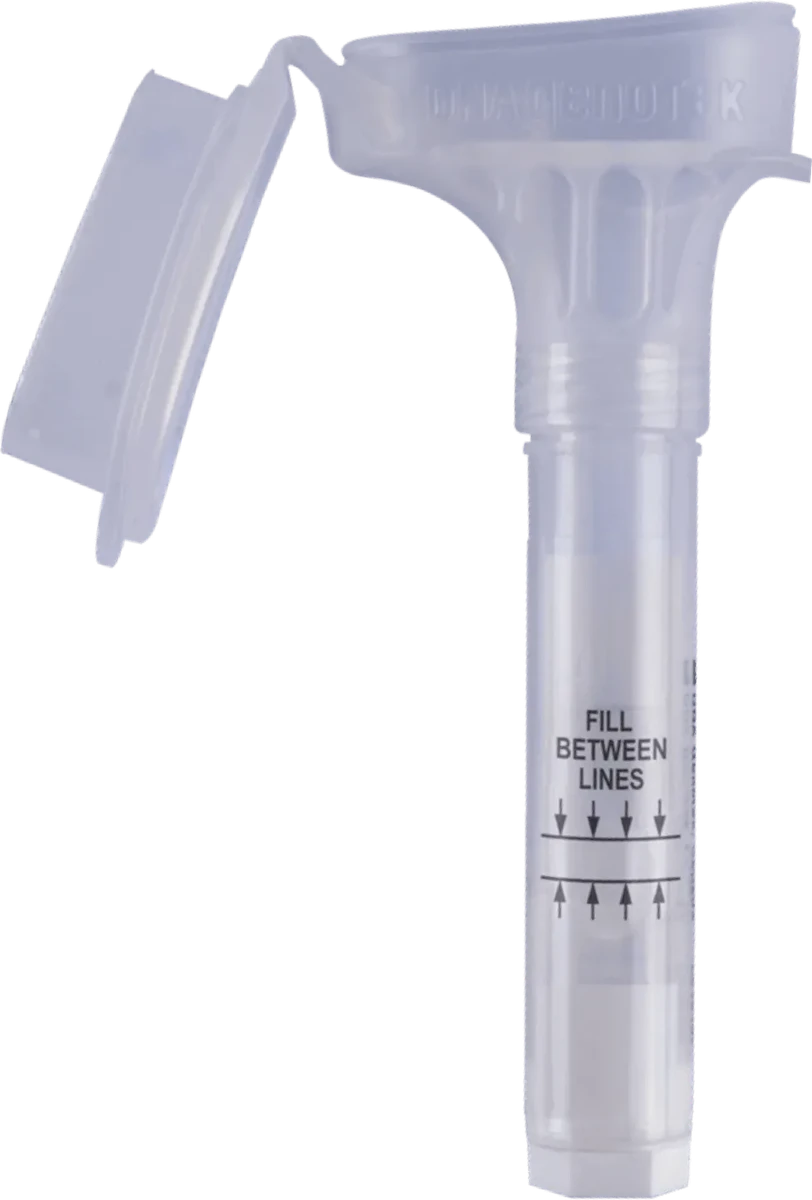
Both saliva devices on the platform are made by DNA Genotek, whose stabilising chemistry keeps DNA intact at room temperature, five years by the maker’s own figure. ORAgene is the spit device: a full sample to the fill line, for genotyping, sequencing and biobanking. ORAcollect is the assisted device: a sponge in the cap swabs the mouth for children, infants and anyone who cannot spit on cue, and stabilises the DNA the same way. Humans Nexus curates and supplies both and assembles the regulated kit around them; DNA Genotek is the manufacturer.
From collection to lab.
For DNA, the patient spits to the fill line of an ORAgene tube, or an ORAcollect sponge swabs the inside of the mouth when spitting is not an option, and closing the cap releases the stabilising buffer. For hormone panels, a timed passive-drool or swab collection into the laboratory’s validated tube. A few minutes, no needle, no clinician.
Sealed and ID-matched, the kit returns by tracked courier at ambient temperature: stabilised saliva DNA needs no cold chain, and a temperature trace is added only where a hormone panel requires one.
The laboratory accessions the sample under the same chain of custody, and the result returns through the platform into your system.
A validated panel.
Oral-microbiome sequencing runs on the same route once the collection protocol is fixed, because how saliva is collected changes what the sequencer sees. The reading list →
Why saliva.
Steroids diffuse into saliva unbound from their carrier proteins, so saliva carries the free, biologically active fraction: for cortisol and the androgens it is often the better matrix than blood, and it is the only practical way for a patient to capture a multi-point daily cortisol curve at home. For DNA, a stabilised saliva sample genotypes as well as blood, which is why large genetics studies and biobanks moved to it. Saliva also reaches the patients blood draws lose: children, the needle-averse, the remote. It is not a universal substitute: estradiol sits below quantification in saliva and progesterone is detected too rarely to report, and stimulated salivary cortisol does not replace serum cortisol in children, so every analyte is validated in saliva before a laboratory reports it.
What the record shows.
Each figure below belongs to the assay and the cohort that produced it. Where a paper’s abstract does not name the collection device, none is named here.
Each analyte is validated in saliva by the laboratory before it is reported. The full reading list follows below.
Sealed. Tracked.
Ambient-stable.
The stabilising buffer preserves DNA at room temperature from the moment the cap closes. Every kit is ID-matched and sealed, its UDI bound to a chain of custody at activation and tracked by courier scan to accessioning; a temperature trace is added only where a hormone panel requires one. Each analyte is validated in saliva by the laboratory before it is reported.
What’s in the box.
Saliva | Cell
- ORAgene or ORAcollect device, stabilising buffer in the cap
- ID-matched, tamper-evident seal
- Tracked return packaging
- Guided collection in Flow, step by step
Whoever runs the test.
Infrastructure for healthcare and life sciences. Our partners reach the patient, and we never sell directly.
Good to know.
Is saliva as reliable as blood for hormones?
For the free-fraction steroid hormones, cortisol and the androgens above all, saliva is often the preferred matrix: it reflects the biologically active, unbound hormone and allows non-invasive, multi-point daily sampling a venous draw cannot match. Estradiol and progesterone are not reliably quantified in saliva, and each analyte is validated in saliva before it is reported.
Which analytes can saliva measure?
Germline DNA for genotyping, pharmacogenomics and sequencing; the free steroid hormones, salivary cortisol and cortisone, testosterone, androstenedione and DHEA; viral and bacterial nucleic acid and antibodies where the assay is validated for oral fluid; and the oral microbiome under a fixed collection protocol, all from an at-home or point-of-care collection.
Is saliva DNA as good as blood DNA for genotyping?
In paired samples, genotypes from stabilised saliva agreed with blood at 99.996%, and hereditary-cancer sequencing on saliva reached 98% variant concordance. Saliva also carries bacterial DNA, so a laboratory checks human-DNA content before an array, and a few percent of samples in a large elderly cohort fell below the yield threshold, the case for a repeat collection.
Which saliva collection device do you use?
ORAgene for a full spit sample and ORAcollect for assisted collection by sponge, both made by DNA Genotek, both stabilising DNA at the moment of collection. Humans Nexus curates and supplies them and assembles the regulated kit around them.
How is the sample kept stable in transit?
For DNA, the stabilising buffer released when the cap closes keeps the sample intact at room temperature, for years by the maker’s figure, so it ships without a cold chain. Hormone samples are collected at set times and, where the panel requires it, carry a temperature trace to the laboratory.
Who collects the sample?
The patient, at home, guided step by step in Flow, or a clinician at the point of care; no phlebotomist and no clinic visit.
Can children give a saliva sample?
Yes. ORAcollect’s sponge collects from children and infants who cannot spit on cue, at home under a parent’s supervision or at the point of care, with no needle involved. Pediatric microsampling →
Can salivary cortisol replace a blood cortisol test?
For screening and for diurnal profiling, often: late-night salivary cortisol is a first-line screen for Cushing syndrome, and in adults a stimulated salivary cortisol measured by LC-MS/MS reaches 89% diagnostic accuracy for adrenal insufficiency. It does not replace serum cortisol in the low-dose stimulation test in children, and a single elevated value confirms nothing on its own.

Library Saliva microsampling
Every paper read and summarised in our own words, each on a page of its own in the OpenSampling Library.
Newest
Comparison of self-collected oral swabs for supragingival microbiome characterization using 16S rRNA gene amplicon sequencing
Read in the LibraryLong-term stability at -80°C of oral wash and saliva samples for microbiome analyses
Read in the LibraryClinical validation of a patient-friendly saliva microsampling approach to monitor perampanel levels in people with epilepsy
Read in the LibraryRepeated Unstimulated Whole Saliva Collection: A Reliable Approach to Improve Diagnostic Accuracy
Read in the LibraryNanostructured zinc-coordination supraparticles on cellulose fibers: A 3D-Printed μ-FAD integrated smartphone platform for multiplexed salivary metabolic monitoring
Read in the LibraryCommunity singing intervention reduces maternal salivary cytokines and enhances maternal-infant cortisol synchrony in postnatal depression: biological findings from the SHAPER-PND trial
Read in the Library
Hormones & steroids
Community singing intervention reduces maternal salivary cytokines and enhances maternal-infant cortisol synchrony in postnatal depression: biological findings from the SHAPER-PND trial
Read in the LibraryIntraindividual Variability of the Cortisol Awakening Response, Sleep Dynamics, Stress, and Emotion in Two Persons With Poststroke Aphasia
Read in the LibrarySalivary estradiol and progesterone across the menstrual cycle: Association and agreement with serum concentrations
Read in the LibraryThe Utility of Salivary 11-Dehydrodexamethasone as a Marker of Dexamethasone Absorption
Read in the LibraryUltrasensitive de novo Protein Sandwich Lateral flow Fluorescence Assay for Cortisol in Saliva and Serum using Quantum dots and Europium Nanoparticles
Read in the LibraryRepeat At-Home Saliva Collection to Measure Cortisol Awakening Response (CAR): Protocol Feasibility Study Among Black Women With Histories of Abuse
Read in the Library
Germline DNA & genotyping
Study design with responsible return of results for a fully remote genome sequencing study in individuals with Prader-Willi syndrome
Read in the LibraryCollecting at-Home Biometric Measures for Longitudinal Research From the i3C: Feasibility and Acceptability Study
Read in the LibraryMetagenome-assembled genomes enhance bacterial read decontamination and variant calling in oral samples
Read in the LibraryHuman Papilloma Virus (HPV) Detection in Oral Rinse vs. Oral Sponge: A Preliminary Accuracy Report in Oral Cancer Patients
Read in the LibraryPediatric pharmacogenetics: profiling CYP2C8 polymorphisms at King Abdulaziz University Dental Clinic
Read in the LibraryA Systematic Literature Review on the Use of Dried Biofluid Microsampling in Patients With Kidney Disease
Read in the Library
Microbiome
Comparison of self-collected oral swabs for supragingival microbiome characterization using 16S rRNA gene amplicon sequencing
Read in the LibraryLong-term stability at -80°C of oral wash and saliva samples for microbiome analyses
Read in the LibraryCollecting at-Home Biometric Measures for Longitudinal Research From the i3C: Feasibility and Acceptability Study
Read in the LibraryOral, Vaginal, and Stool Microbial Signatures in Patients With Endometriosis as Potential Diagnostic Non-Invasive Biomarkers: A Prospective Cohort Study
Read in the LibraryMetagenome-assembled genomes enhance bacterial read decontamination and variant calling in oral samples
Read in the LibrarySaliva sampling method influences oral microbiome composition and taxa associated with oral diseases
Read in the Library
One free account opens every finding in the OpenSampling Library. The same account signs you in to Pulse.
These citations describe the published evidence for the collection formats and devices, not claims about specific Humans Nexus assays, which are validated per analyte and per laboratory.
Put saliva on the platform.
Talk to us about adding saliva collection to your programme.