ORAgene.
A full saliva sample, DNA locked in.
ORAgene is DNA Genotek’s flagship spit device: the patient spits to the fill line, 2 mL in the standard configuration, and closing the lid releases a stabilising buffer that preserves high-molecular-weight DNA at the point of collection, a median 110 µg by the maker’s figure, stable at room temperature for years, for sequencing, genotyping and biobanking in an accredited laboratory. Curated and supplied on the Humans Nexus platform; DNA Genotek is the manufacturer.
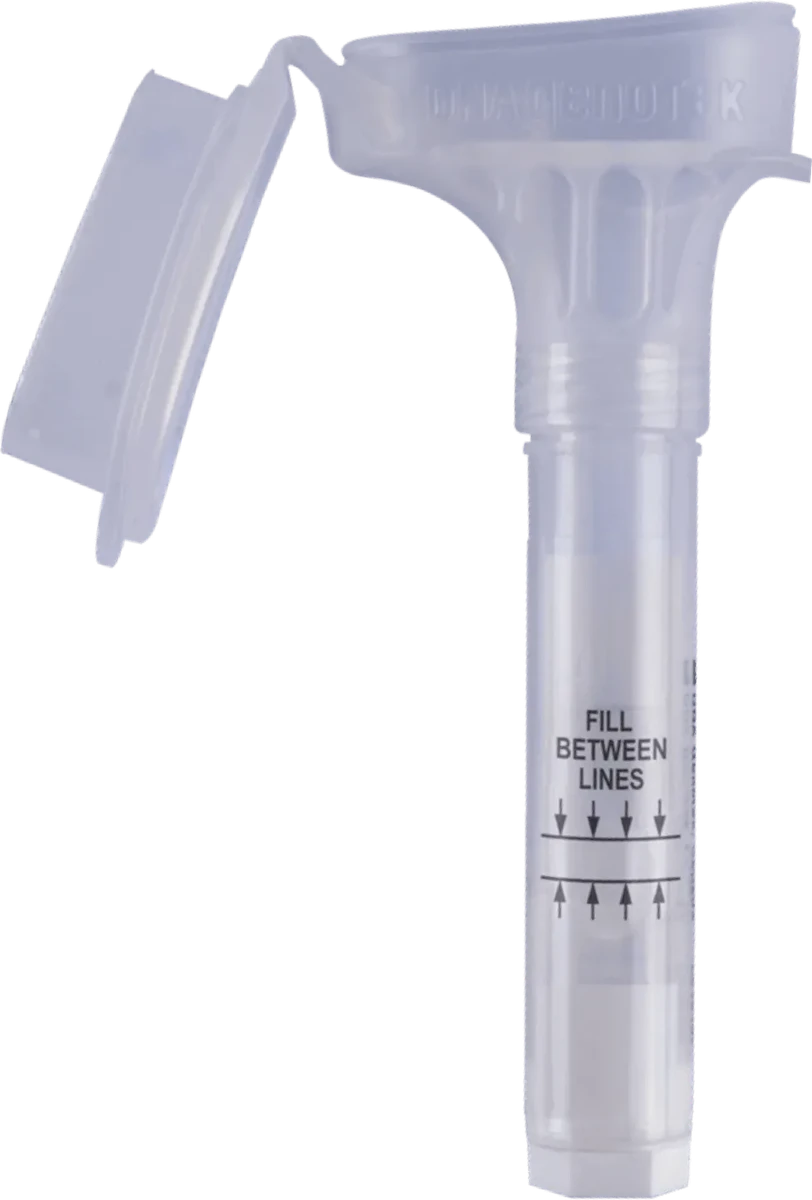
ORAgene saliva self-collection.
ORAgene is a saliva microsampling device from DNA Genotek built for self-collection: the patient spits into a funnel on top of the tube until a full sample is reached, then closes the lid, which releases a stabilising buffer that mixes with the saliva and preserves the DNA at the moment of collection. Per the manufacturer, the larger sample yields high-molecular-weight DNA suited to whole-genome sequencing, genotyping and long-term biobanking, and the ambient-stable tube travels at room temperature and reaches the laboratory intact. Humans Nexus curates and supplies the device on its platform and assembles the clinical-grade kit around it; DNA Genotek is the legal manufacturer.
In the maker’s own figures, the standard configuration, OG-500, collects 2 mL of saliva and yields a median 110 µg of DNA, and is labelled for in vitro diagnostic use outside the United States; the Dx configuration, OGD-500, is FDA-cleared for in vitro diagnostic use, K192920, stated at five years of room-temperature stability, and in the maker’s clinical study 97% of samples reached 5 ng/µL and 96% passed the sequencing call-rate criteria. Device-level regulatory status is held by DNA Genotek.
A generous sample,
DNA for the long run.
Saliva is a non-invasive way to reach germline DNA, but oral fluid degrades quickly once collected and yield varies from person to person. ORAgene is designed by the manufacturer to capture a larger volume and stabilise it at collection, so an ambient-stable tube can travel by ordinary tracked post and still deliver the high-molecular-weight DNA that sequencing and biobanking need.
What the record shows. In a mostly elderly cohort, 2,344 saliva samples self-collected in Oragene kits: genotypes agreed with blood at 99.996% in paired samples, call rates were above 99% for 43 of 44 saliva DNAs, and 94% of specimens yielded at least 10 ng/µL (BMC Medical Genomics, 2016). On a pharmacogenomic array, Oragene saliva DNA agreed with blood at 98.7% of calls, with a lower call rate where bacterial DNA diluted the human fraction (PLoS ONE, 2012). Both papers name the device in their methods.
Which saliva device?
Two DNA Genotek saliva devices, one decision: how the sample is given. ORAgene takes a full spit through a funnel, the higher-yield route for adult self-collection. ORAcollect uses a sponge in the cap to collect or swab, the gentler option for children, infants and anyone who can’t spit on cue.
| ORAgene | ORAcollect | |
|---|---|---|
| Collection | Spit into the funnel | Sponge in the cap, collect or swab |
| Best suited to | Adult self-collection | Children, infants & assisted collection |
| Typical volume | Larger, a full saliva sample | Smaller, targeted |
| DNA yield | High-molecular-weight DNA, sequencing & biobanking | Ready DNA for routine molecular tests |
| Stabilisation | Liquid buffer, ambient for years, per the maker | Liquid buffer, ambient for months, per the maker |
| Lab handling | Standard robotics, no tip-cutting | Standard robotics, no tip-cutting |
Both share DNA Genotek’s liquid stabilisation, a bacteriostatic buffer that holds DNA at room temperature, for years with ORAgene and for months with ORAcollect by the maker’s own pages, and both run on standard laboratory robotics without tip-cutting. The right device depends on who collects and what the assay needs; method validation runs per assay before patient-facing reporting. See ORAcollect →
Spit. Stabilise. Return.
The patient spits into the funnel at home until a full saliva sample is collected, with no clinic and no clinician.
Closing the lid releases the stabilising buffer, which mixes with the saliva and locks the DNA at ambient temperature.
Ships by tracked return with no cold chain; the lab processes the stabilised sample.
Assembled into a kit.
The ORAgene device is curated onto the platform and assembled into a regulated Humans Nexus collection kit: device, stabilising buffer, tamper-evident return packaging and app-guided instructions, under its own UDI.
For genetics and biobanking.
Good to know.
What does ORAgene collect?
Saliva. It is a self-collection device: the patient spits into a funnel to give a full saliva sample, which is stabilised at collection for high-molecular-weight, oral-fluid DNA.
How is it different from ORAcollect?
ORAgene is a spit device for adult self-collection and a larger, higher-yield sample; ORAcollect uses a sponge in the cap to collect or swab, which suits children, infants and assisted collection. Both are DNA Genotek saliva devices sharing the same liquid stabilisation.
How much DNA does ORAgene yield?
A median 110 µg from a 2 mL sample in the standard configuration, per the maker; in the maker’s clinical study of the Dx configuration, 97% of samples reached a DNA concentration of 5 ng/µL or more.
How long is the sample stable at room temperature?
Years, per the maker; the Dx configuration is stated at five years of room-temperature stability on the maker’s page.
Does it need cold chain?
No. Per the manufacturer, the device stabilises the sample at collection, so the ambient-stable tube is designed to ship at room temperature by standard tracked return.
Is ORAgene CE marked?
The maker’s pages state FDA clearance for the Dx configuration and label the standard configuration for in vitro diagnostic use outside the United States; no CE statement appears there, so Humans Nexus claims none. Device-level regulatory status is held by DNA Genotek, and each assay is validated in an ISO 15189-accredited laboratory before a patient-facing result.
Who is the manufacturer?
DNA Genotek makes the device. Humans Nexus curates and supplies it on the platform and assembles the clinical-grade kit around it. Method validation runs per assay before patient-facing reporting.

Library Oragene
Collecting at-Home Biometric Measures for Longitudinal Research From the i3C: Feasibility and Acceptability Study
Read in the LibraryPediatric pharmacogenetics: profiling CYP2C8 polymorphisms at King Abdulaziz University Dental Clinic
Read in the LibraryGenetic Risk, Neighborhood Characteristics, and Behavioral Difficulties Among African American Adolescents Living in Very Low-Income Neighborhoods
Read in the LibraryAllele frequency and genotype distribution of the opioid receptor μ-1 (OPRM1) A118G polymorphism in the Western Saudi population
Read in the LibraryObtaining miRNA from Saliva-Comparison of Sampling and Purification Methods
Read in the LibraryIsolation of salivary cell-free DNA for cancer detection
Read in the Library
One free account opens every finding in the OpenSampling Library. The same account signs you in to Pulse.
These citations describe the published evidence for the collection formats and devices, not claims about specific Humans Nexus assays, which are validated per analyte and per laboratory.
Put self-collected saliva on your platform.
Talk to us about ORAgene for your programme.