BD Microtainer.
Capillary blood, from the upper arm.
BD Microtainer capillary microcollection tubes take a small, measured volume of whole blood into a tube pre-filled with the additive the assay needs, colour-coded to match the venous tubes a laboratory already runs. On the Humans Nexus platform they are paired with the YourBio TAP® Micro Select, an upper-arm device built to collect straight into the tube: a fuller, more consistent capillary sample, drawn without venepuncture. CE-marked as an IVD under the IVDR, in BD’s words. Curated and supplied on the Humans Nexus platform; BD, Becton Dickinson, is the manufacturer.
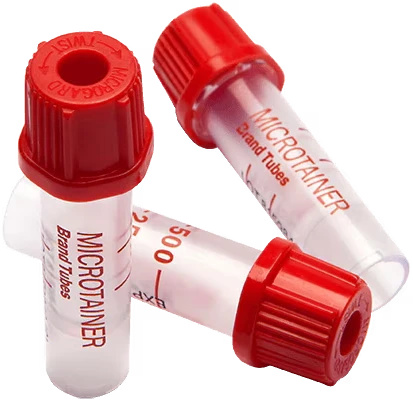
Capillary blood,
in a microtube.
BD Microtainer tubes collect small volumes of capillary blood, 250 to 600 microlitres, into a tube pre-filled with an additive that either keeps the blood liquid or lets it clot, exactly as its venous counterpart does. The caps are colour-coded to the same additive families a laboratory already runs on venous BD Vacutainer tubes, so the microtube drops straight into the existing workflow. On the Humans Nexus platform the tube is paired with the YourBio TAP Micro Select, an upper-arm collector built to fill it directly; Humans Nexus curates and supplies the pairing, and BD is the legal manufacturer.
The upper-arm draw,
without the needle.
A venous draw needs a clinician and a needle. The YourBio TAP Micro Select changes the collection: applied to the upper arm and button-activated, it draws a fuller, more consistent capillary sample straight into the BD Microtainer, the standardised tube the laboratory already trusts. Together they turn capillary blood into something a patient can collect at home and a lab can run like any other sample.
What the record shows. In 31 paired venous and capillary collections, fingerstick blood self-collected into BD Microtainer tubes, posted at ambient temperature and analysed the next day without plasma separation agreed acceptably with paired serum for 11 of 12 analytes, HbA1c, lipids, creatinine, urea, urate, liver enzymes and total protein, with AST the exception (Practical Laboratory Medicine, 2023). Capillary-to-plasma conversion follows the IATDMCT guideline, per analyte, before a result is reported.
One colour per additive.
Every microtube is colour-coded by what is inside it, the same convention as venous blood tubes. Three families carry an anticoagulant that stops the blood clotting, so the cells or the plasma can be analysed; two carry a clot activator, so the blood clots and yields serum. Matching the additive to the assay is what keeps the result valid.
| Cap colour | Additive | Type | Typical use |
|---|---|---|---|
| Lavender | K₂EDTA | Anticoagulant | Haematology, full blood count |
| Green / mint | Lithium heparin, with or without separator gel, PST | Anticoagulant | Plasma chemistry |
| Grey | Sodium fluoride + Na₂EDTA | Anticoagulant & glycolysis inhibitor | Glucose, lactate |
| Gold | Clot activator and separator gel, SST | Clot activator | Serum chemistry |
| Red | Clot activator / silicone-coated | Clot activator | Serum |
Cap colours follow BD’s convention and mirror the venous BD Vacutainer range; the exact additive and fill volume are chosen per assay with the laboratory, and where more than one tube is drawn the laboratory’s order of draw applies. Fill lines on the tube mark the right volume, which keeps the blood-to-additive ratio the assay needs, and the BD Microgard closure is designed to reduce blood splashing when the tube is opened. Blood on the platform →
Apply. Collect. Return.
The YourBio TAP Micro Select is placed on the upper arm and activated: a halo of microneedles, no lancet.
Capillary blood flows into the BD Microtainer and mixes with its additive, a fuller, more consistent sample.
Cap and gently invert to distribute the additive, then return by tracked logistics for the validated assay.
Assembled into a kit.
BD Microtainer is curated onto the platform and assembled into a regulated Humans Nexus collection kit: the right additive tube, the YourBio TAP Micro Select upper-arm collector, tamper-evident return packaging and app-guided instructions, under its own UDI. It is CE-marked as an IVD under the IVDR; device-level regulatory status is held by BD, and method validation runs per assay before patient-facing reporting.
For blood work, from home.
Good to know.
How is the blood collected?
On the Humans Nexus platform, with the YourBio TAP Micro Select, an upper-arm device that draws capillary blood in a fuller and more consistent volume, straight into the BD Microtainer. No venepuncture and no clinician are required.
How much blood does it take?
A small volume of capillary blood: the BD Microtainer holds 250 to 600 microlitres, far less than a venous tube. The exact fill depends on the tube and the assay.
Which tube do I need?
The tube is chosen by additive, and the cap colour identifies it: lavender K₂EDTA for a full blood count, green lithium heparin for plasma chemistry, grey fluoride for glucose, and gold or red for serum. The laboratory specifies the tube per assay.
Is it an anticoagulant tube?
It depends on the cap. The lavender EDTA, green lithium-heparin and grey fluoride tubes carry an anticoagulant; the gold SST and red tubes carry a clot activator and yield serum instead.
What is its regulatory status?
BD Microtainer tubes are in vitro diagnostic medical devices, CE-marked in compliance with the In Vitro Diagnostic Medical Devices Regulation (EU) 2017/746, in BD’s words. Device-level regulatory status is held by BD; Humans Nexus assembles the regulated kit around it.
Is capillary blood in a Microtainer as accurate as serum?
For most routine chemistry, the record says yes: in 31 paired collections, fingerstick blood self-collected into Microtainer tubes and posted at ambient temperature agreed acceptably with serum for 11 of 12 analytes, AST excepted, after a day in the post. Each analyte is still validated per assay before a result is reported.
How long can the tube travel?
In that study, 24 hours at ambient temperature by mail, with delayed centrifugation at the laboratory. The laboratory sets the window per assay, and controlled-temperature transport is used only where a panel requires it.
Who is the manufacturer?
BD, Becton Dickinson, makes the Microtainer tubes; YourBio Health makes the TAP Micro Select collector. Humans Nexus curates and supplies them together on the platform. Method validation runs per assay before patient-facing reporting.

Library BD Microtainer
Prevalence of chlamydial, gonococcal and syphilis positivity by anatomical site and sex via self-collected biospecimens using at-home testing kits among a large and diverse cohort of men and women enrolled in the MACS/WIHS Combined Cohort Study (MWCCS) in the USA
Read in the LibraryImplementation of a Capillary Blood Self-Sampling Technique at Home for Monitoring of Patients With IBD
Read in the LibraryAt-home blood collection for clinical chemistry analyses in a kidney transplant population: a feasibility study
Read in the LibraryTo the homeRNAmax: Developing an Improved Blood Self-Collection and Stabilization Platform for Remote Transcriptomic Studies
Read in the LibraryComparing capillary blood collection technologies: patient experience, device performance and clinical accuracy
Read in the LibraryEvaluation of a Simplified Upper-Arm Device for Vacuum-Assisted Collection of Capillary Blood
Read in the Library
One free account opens every finding in the OpenSampling Library. The same account signs you in to Pulse.
These citations describe the published evidence for the collection formats and devices, not claims about specific Humans Nexus assays, which are validated per analyte and per laboratory.
Put upper-arm capillary blood on your platform.
Talk to us about BD Microtainer with the YourBio TAP Micro Select for your programme.