OMNIgene·GUT.
Microbiome DNA that survives the journey.
OMNIgene·GUT is DNA Genotek’s stool collection kit for the gut microbiome: a spoonful of stool into a tube of stabilising liquid, and the microbial DNA is fixed as it was in the body, stable at ambient temperature for 60 days by the maker’s figure, with no cold chain, ready for 16S, shotgun metagenomic and qPCR work in an accredited laboratory. Curated and supplied on the Humans Nexus platform; DNA Genotek is the manufacturer.
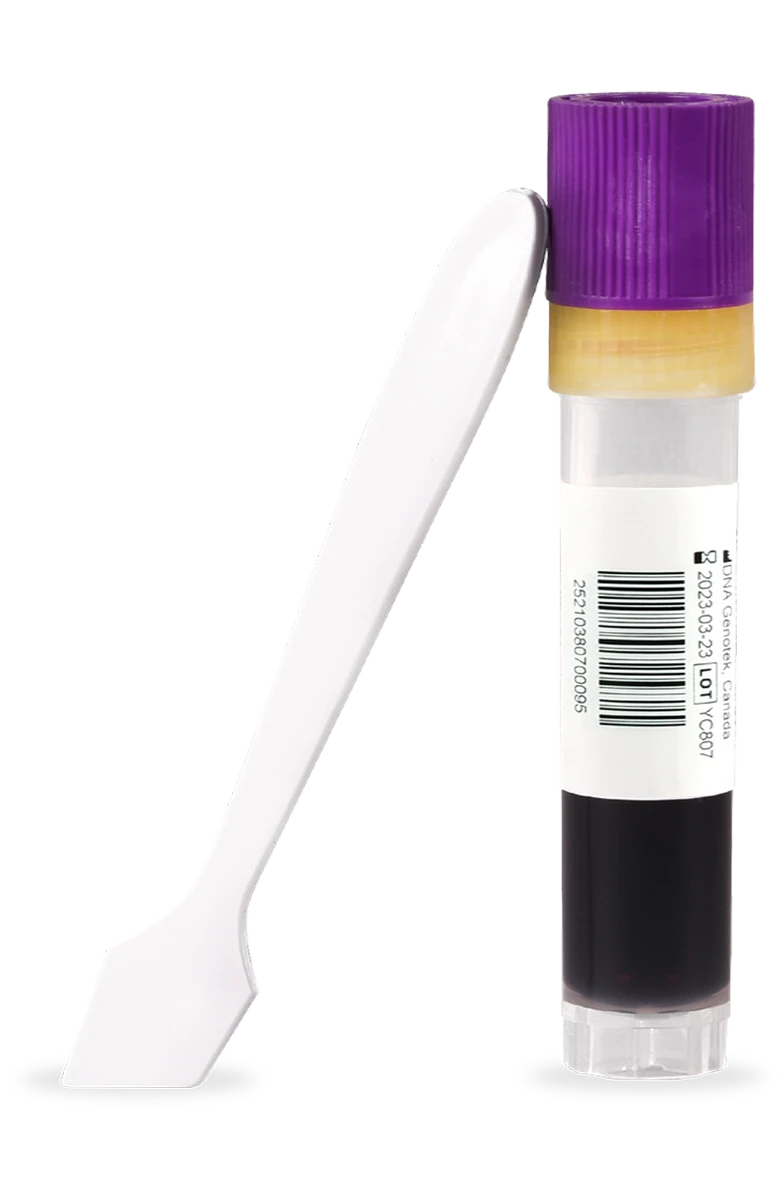
OMNIgene·GUT stool collection.
OMNIgene·GUT is a stool microsampling device from DNA Genotek: the patient collects a small stool sample directly into the tube, and closing it mixes the sample with a stabilising buffer that locks the microbial profile at the point of collection. Per the manufacturer, the ambient-stabilised stool then travels at room temperature and reaches the laboratory without the degradation a raw sample would suffer in the post. Humans Nexus curates and supplies the device on its platform and assembles the clinical-grade kit around it; DNA Genotek is the legal manufacturer.
In the maker’s own figures, the kit collects a median 520 mg of stool, holds the DNA through ambient swings from −20 °C to 50 °C, keeps it stable at room temperature for 60 days, and yields around 12 µg of DNA per extraction, eight extractions to a kit. OMNIgene·GUT has carried a CE-IVD mark in Europe since the maker’s 2015 announcement and is research use only in the United States; device-level regulatory status is held by DNA Genotek.
Ambient-stabilised stool,
microbiome-ready.
A stool sample begins to shift the moment it leaves the body, which is why microbiome and GI work has historically leaned on cold chain. OMNIgene·GUT is designed by the manufacturer to lock the profile at collection, so an ambient-stabilised stool sample can travel by ordinary tracked post and still represent what was collected.
What the record shows. In 17 stem-cell-transplant patients, stool placed in OMNIgene·GUT and frozen later gave 16S and shotgun profiles statistically indistinguishable from fresh-frozen aliquots of the same specimen (Scientific Reports, 2019); the paper’s methods name the device. And in 16 infants the maker’s metabolomics sibling, OMNImet·GUT, recovered 94.5% of the metabolites seen in flash-frozen stool (BMC Microbiology, 2021).
Collect. Stabilise. Return.
The patient collects a small stool sample, about half a gram, into the OMNIgene·GUT tube with the spoon or toilet accessory, at home.
Closing the tube and shaking it mixes the sample with the stabilising liquid, which fixes the microbial DNA at ambient temperature.
Ships by standard tracked return with no cold chain, inside the maker’s 60-day window; the laboratory extracts and sequences the stabilised sample.
Assembled into a kit.
The OMNIgene·GUT device is curated onto the platform and assembled into a regulated Humans Nexus collection kit: device, stabilising buffer, tamper-evident return packaging and app-guided instructions, under its own UDI.
For microbiome and GI work.
Good to know.
What is OMNIgene·GUT used for?
Stool, stabilised at the point of collection, for 16S rRNA microbiome profiling, shotgun metagenomic sequencing, qPCR and arrays, per the maker: microbiome and gastrointestinal work, from the home or the point of care.
Does it need cold chain?
No. Per the manufacturer, the stabilising liquid fixes the microbial DNA at collection, so the sample ships at room temperature by standard tracked return, within the maker’s 60-day window.
How does the stabilisation work?
Closing the tube and shaking it mixes the stool with a stabilising liquid that fixes the microbial DNA and preserves the community profile for ambient transport, so the sample reaches the laboratory without the degradation a raw sample would suffer in the post.
How long is the sample stable at room temperature?
60 days by the maker’s figure, with DNA integrity maintained through ambient swings from −20 °C to 50 °C.
Is OMNIgene·GUT CE marked?
Yes. OMNIgene·GUT has carried a CE-IVD mark in Europe since the maker’s 2015 announcement and is research use only in the United States. Device-level regulatory status is held by DNA Genotek; each assay is validated in an ISO 15189-accredited laboratory before a patient-facing result.
How much stool does it collect?
A median 520 mg per the maker, yielding around 12 µg of DNA per extraction, with eight extractions to a kit.
Does it stabilise RNA as well?
No. OMNIgene·GUT stabilises DNA; the maker’s DNA-and-RNA kit is a separate product that is not on the platform.
Who is the manufacturer?
DNA Genotek makes the device. Humans Nexus curates and supplies it on the platform and assembles the clinical-grade kit around it. Method validation runs per assay before patient-facing reporting.

The research library.
Detection of Cryptosporidium hominis by clinical metagenomics in stool samples from an outbreak of diarrhoea among British military personnel in Kenya
Read in the LibraryPerioperative Antibiotic Prophylaxis in Cesarean Section and the Maternal Gut Microbiome: Protocol for a Remote Observational Cohort Study
Read in the LibraryProspective evaluation of different faecal preservation media for travellers' diarrhoea diagnostic application with multiplex PCR BioFire FilmArray in resource-limited settings
Read in the LibraryStabilized and unstabilized sampling methods result in differential fecal 16S rRNA microbial sequencing results
Read in the LibraryAssociation of Gut Dysbiosis with Disease Phenotype and Treatment in Systemic Lupus Erythematosus
Read in the LibraryField expedient stool collection methods for gut microbiome analysis in deployed military environments
Read in the Library
One free account opens every finding in the OpenSampling Library. The same account signs you in to Pulse.
These citations describe the published evidence for the collection formats and devices, not claims about specific Humans Nexus assays, which are validated per analyte and per laboratory.
Put stabilised stool on your platform.
Talk to us about OMNIgene·GUT for your programme.